# Exam 2  - Notes

# Chapter 35

## Introduction to Plants

### Kingdom Plantae

- We will primarily be discussing the angiosperms 
    - Phylum Anthophyta
- Flowers and fruits 
    - Only group that does/has these things
- Advanced traits 
    - Seeds
    - Advanced vascular tissues

### From seed to seed

#### The life of a flowering plant

- Seeds 
    - reproductive structures produced by angiosperms and other seed plants
    - usually the result of sexual reproduction
    - contains embryos that develop into seedlings upon germination
    - has survival value

#### Alternation of Generations

- Exhibited by all plants (and plant-like organisms) that have sexual reproduction
- There is an alternation between a diploid (2N) form \[sporophyte\] and a haploid (1N) form \[gametophyte\]

##### Gametophyte (haploid)

- Gamete-producing plant fomr
- multicellular
- microscopic in flowering plants 
    - female 
        - embryo sac with egg
    - male 
        - pollen grain
- grow and develop within flowers of angiosperms
- produces gametes by mitosis/cytokineses

##### Sporophyte (diploid)

- multicellular
- large "plant" in flowring plant
- produces haploid spores by meiosis (reduction) 
    - called meiospores

[![Screenshot-from-2019-02-26-15-58-38.png](https://bookstack.aronwk.com/uploads/images/gallery/2019-02-Feb/scaled-840-0/EWmCJ9pSt3l2cWKw-Screenshot-from-2019-02-26-15-58-38.png)](https://bookstack.aronwk.com/uploads/images/gallery/2019-02-Feb/EWmCJ9pSt3l2cWKw-Screenshot-from-2019-02-26-15-58-38.png)

[![Screenshot-from-2019-02-26-16-00-28.png](https://bookstack.aronwk.com/uploads/images/gallery/2019-02-Feb/scaled-840-0/H2QiK957RFY8COlF-Screenshot-from-2019-02-26-16-00-28.png)](https://bookstack.aronwk.com/uploads/images/gallery/2019-02-Feb/H2QiK957RFY8COlF-Screenshot-from-2019-02-26-16-00-28.png)

## The plant embryo

- Fertilization (syngamy) results in the formation of a diploid zygote, which undergoes mitosis to form an embryo (multicellular)
- the embryo is a sporophyte that lies dormant in the seed with a supply of stored food and a seed coat
- may lay dormant for long periods until conditions are favorable

## The plant body

Composed of three organ types

- stems
- leaves
- roots

### Shoot system

- stem 
    - produce leaves and branches and bear the reproductive structures
- leaves 
    - flattened structure specialized for photosynthesis

### Root system

- roots 
    - Provide anchorage in the soil and foster efficient uptake of water and minerals
    - can store food

## Growth

- Indeterminate growth 
    - increasing in size as long as the plant is alive
- grows into a seedling and then a mature plant
- Plant growth occurs by 3 means 
    - Increase in number of cells 
        - cellular reproduction 
            - (mitosis/cytokineses)
    - increase in cell size 
        - elongation
    - increase in weight/mass

### Development

- Mature plants produce reproductive structures 
    - flowers
    - seeds
    - fruits
- flowers and floral buds are reproductive shoots that develop when shoot apical (tip) meristems produce flower parts instead of new tissues and leaves
- flowers are produced by determinate growth

### Seed coats

- Flower tissues enclose and protect tiny male and female gametophytes 
    - sperm in pollen fertilizes the egg, triggering ovules to develop into seed and flower parts to develop into fruit
- fruits enclose seeds and function in seed dispersal 
    - Angiosperms

[![Screenshot-from-2019-02-26-17-00-05.png](https://bookstack.aronwk.com/uploads/images/gallery/2019-02-Feb/scaled-840-0/fGG0vidbb24sxcwx-Screenshot-from-2019-02-26-17-00-05.png)](https://bookstack.aronwk.com/uploads/images/gallery/2019-02-Feb/fGG0vidbb24sxcwx-Screenshot-from-2019-02-26-17-00-05.png)

### Meristems

- Seedlings and mature plants produce new tissue from meristems 
    - cell factories
- meristem is a region of undifferentiated cells that produce new tissue by cell division
- A dormant meristem occurs at the shoot and root of seed embryos 
    - activate in seedlings
- mature plants have shoot apical meristems (SAM) and root apical meristems (RAM)

### Mature sporophyte develop from seedlings

- photosynthesis powers the transformation of seedlings into mature plants
- provides the ability to produce organic food
- plants undergo both vegetative growth and reproductive development

#### Hierarchy of structures in a mature plant

- Specialized cells
- tissues
- organs
- organ systems 
    - branches, buds, flowers, seeds, fruits
- root and shoot systems
- plant (the organism itself)

### Primary Growth

- Elongation of plant organs
- roots, stems, and leaves
- Occurs in ALL plants
- Produces primary tissues from apical meristems (SAM and RAM)

#### Primary Tissues

- Primary xylem 
    - vascular/conducting tissue
    - water and minerals
- Primary phloem 
    - vascular/conducting tissue
    - food and solutes
- Epidermis 
    - dermal 
        - Outter-most tissue
    - protection
    - holds water in plant
- Support ground tissues 
    - Parenchyma 
        - most abundant type
        - storage 
            - water and food
        - part of cortex/pith
    - Collenchyma 
        - Protection/support of growing plant organs
        - cortex
    - Sclerenchyma 
        - protection/support of non-elongating organs
        - cortex

### Secondary Growth

- Expansion of plant organs 
    - lateral meristems
- roots and stems only 
    - does not occur in leaves
- noes not occur in all plants
- Produces secondary tissues 
    - woody tissues

## Major groups of Angiosperms

### Eudicots

- &gt;240,000 species
- all have primary growth
- most have secondary growth 
    - for this class we are saying they all have secondary growth

### Monocots

- &gt;60,000 species
- all have primary growth
- very few have secondary growth 
    - for this class we are saying that non have secondary growth
- grasses, corn, tulips, lilies

## Root system adaptations

### Major functions

- absorbing water and minerals
- anchoring the plant in the soil
- storing nutrients and water

#### Eudicots

Taproots

[![Screenshot-from-2019-02-26-18-53-37.png](https://bookstack.aronwk.com/uploads/images/gallery/2019-02-Feb/scaled-840-0/J7qi1b81Z7bgWQhy-Screenshot-from-2019-02-26-18-53-37.png)](https://bookstack.aronwk.com/uploads/images/gallery/2019-02-Feb/J7qi1b81Z7bgWQhy-Screenshot-from-2019-02-26-18-53-37.png)

#### Monocots

fibrous roots

[![Screenshot-from-2019-02-26-18-53-45.png](https://bookstack.aronwk.com/uploads/images/gallery/2019-02-Feb/scaled-840-0/2lu7qXPIFEybIUXS-Screenshot-from-2019-02-26-18-53-45.png)](https://bookstack.aronwk.com/uploads/images/gallery/2019-02-Feb/2lu7qXPIFEybIUXS-Screenshot-from-2019-02-26-18-53-45.png)

### Three zones of root growth

1. Region of cell division 
    - RAM and root cap
    - RAM contains cells that ar dividing
    - Quiescent center keeps nearby cells undifferentiated
    - Root cap embedded in mucigel 
        - Mucigel is a slimy substance that covers the root cap of the roots of plants.
2. Region of elongation 
    - cells extend by uptake of water
3. Region of maturation 
    - root cell differentiation and tissue specialization
    - identified by presence of root hair 
        - water and mineral uptake

[![Screenshot-from-2019-02-26-19-00-06.png](https://bookstack.aronwk.com/uploads/images/gallery/2019-02-Feb/scaled-840-0/9uQ5eibWqgokbDIc-Screenshot-from-2019-02-26-19-00-06.png)](https://bookstack.aronwk.com/uploads/images/gallery/2019-02-Feb/9uQ5eibWqgokbDIc-Screenshot-from-2019-02-26-19-00-06.png)

### Root Internal Structure

- Epidermis of mature roots encloses a cylinder of parenchyma called the root cortex 
    - One cell thick
    - often rich in starch 
        - functions as food storage
    - many contain inter-cellular air spaces
- Endodermis 
    - selective absorption of minerals
    - one cell thick
- Meristematic pericycle 
    - encloses root in vascular tissues
    - provides lateral branches
- woody roots produce primary vascular tissues followed by secondary vascular tissues

#### Eudicot root

[![gb110629_young_dicot_root400.jpg](https://bookstack.aronwk.com/uploads/images/gallery/2019-02-Feb/scaled-840-0/2ABWpCGikmznHja3-gb110629_young_dicot_root400.jpg)](https://bookstack.aronwk.com/uploads/images/gallery/2019-02-Feb/2ABWpCGikmznHja3-gb110629_young_dicot_root400.jpg)

#### Monocot Root

[![plant-organ-cross-sections-4-638.jpg](https://bookstack.aronwk.com/uploads/images/gallery/2019-02-Feb/scaled-840-0/rUIaZuaDhTDXLzI3-plant-organ-cross-sections-4-638.jpg)](https://bookstack.aronwk.com/uploads/images/gallery/2019-02-Feb/rUIaZuaDhTDXLzI3-plant-organ-cross-sections-4-638.jpg)

## The shoot system

Stem and leaf adaptations

Shoots are modular with 4 parts

1. Stem node 
    - leaves or branches emerge
2. Internode 
    - stem between adjacent nodes
    - elongation
3. Leaf
4. Axillary Meristem 
    - generate axillary buds
    - can produce flowers or branches 
        - Lateral shoots
    - New branches bear SAM at their tips

### Shoot Tip

- Terminal bud 
    - at the end of each shoot
    - includes the SAM and other parts
    - scales

[![Screenshot-from-2019-02-26-20-15-41.png](https://bookstack.aronwk.com/uploads/images/gallery/2019-02-Feb/scaled-840-0/L6PebciohUi8GIl5-Screenshot-from-2019-02-26-20-15-41.png)](https://bookstack.aronwk.com/uploads/images/gallery/2019-02-Feb/L6PebciohUi8GIl5-Screenshot-from-2019-02-26-20-15-41.png)

### Leaf anatomy

[![schematic_gas_exchange_across.png](https://bookstack.aronwk.com/uploads/images/gallery/2019-02-Feb/scaled-840-0/Sn4bFqEygOIzvHXk-schematic_gas_exchange_across.png)](https://bookstack.aronwk.com/uploads/images/gallery/2019-02-Feb/Sn4bFqEygOIzvHXk-schematic_gas_exchange_across.png)

#### Leaf adaptation

##### Leaf venation

Eudicot

- Pinate (feathery)
- Palmate (palm)
- Netted 
    - provides more support for the leaves

Monocot

- Parallel

### Stem

#### Primary growth

- mostly above ground organs,but some modified stems are blow ground 
    - Irish potato 
        - underground stem

#### Eudicot Stem

- ALC
- Primary (elongation) and secondary (expansion) growth
- vascular bundles (xylem and phloem) form a ring pattern
- exhibit both a pith and a cortex
- cambium ring produce cells 
    - provide secondary growth

[![(11).PNG](https://bookstack.aronwk.com/uploads/images/gallery/2019-02-Feb/scaled-840-0/HD9w6L6LSUgsvanp-(11).PNG)](https://bookstack.aronwk.com/uploads/images/gallery/2019-02-Feb/HD9w6L6LSUgsvanp-(11).PNG)

##### Lateral Meristems

- Produces secondary growth
- 2 lateral merstems 
    - both are rings that retain cell division properties and produce secondary tissues to the inside and outside of the cambium ring
- Vascular cambium 
    - produces ring of **secondary xylem (wood)** to the inside and a ring of **secondary phloem (inner bark)** to the outside
- Cork cambium 
    - Produces ring of **periderm (outter bark)** that replaces the epidermis and cortex for external protection

[![Screenshot-from-2019-02-26-21-35-35.png](https://bookstack.aronwk.com/uploads/images/gallery/2019-02-Feb/scaled-840-0/9mGGBwHzFRK33oAq-Screenshot-from-2019-02-26-21-35-35.png)](https://bookstack.aronwk.com/uploads/images/gallery/2019-02-Feb/9mGGBwHzFRK33oAq-Screenshot-from-2019-02-26-21-35-35.png)

- Secondary vascular tissue 
    - woody plants begin life with only primary vascular systems 
        - produces secondary tissues and bark as they mature
    - secondary xylem 
        - wood
    - Secondary phloem 
        - inner part
    - bark has both outer bark (mostly dead cork cells) and inner bark (secondary phloem)
- Secondary growth 
    - begins late in first year of growth
    - eudicot stem after 3 years of growth

[![Screenshot-from-2019-02-26-21-41-28.png](https://bookstack.aronwk.com/uploads/images/gallery/2019-02-Feb/scaled-840-0/CpDkR3lV9BHcnMHG-Screenshot-from-2019-02-26-21-41-28.png)](https://bookstack.aronwk.com/uploads/images/gallery/2019-02-Feb/CpDkR3lV9BHcnMHG-Screenshot-from-2019-02-26-21-41-28.png)

#### Monocot stem

- Primary growth (elongation)
- vascular bundles (xylem and phloem) are scattered
- lacks both pith and cortex

[![191e446a2dca02705221bbb36e44e7d3.png](https://bookstack.aronwk.com/uploads/images/gallery/2019-02-Feb/scaled-840-0/UEbbkStBxBtSJZAZ-191e446a2dca02705221bbb36e44e7d3.png)](https://bookstack.aronwk.com/uploads/images/gallery/2019-02-Feb/UEbbkStBxBtSJZAZ-191e446a2dca02705221bbb36e44e7d3.png)

## Comparison between Plant types

### Leaves

#### Eudicot

- net venation

#### Monocot

- parallel venation

### Roots

#### Eudicot

- primary and secondary growth (mostly)
- cortex
- no pith
- core of xylem in the root

#### Monocot

- Primary growth only
- both cortex and pith

### Stems

#### Eudicot

- primary and secondary growth (mostly)
- vascular bundles in a ring pattern around cortex

#### Monocot

- Primary growth only
- vascular bundles scattered around
- no pith or cortex

## Primary Growth

- Due to activities of Apical Meristems 
    - RAM and SAM
- Results in production of primary growth

## Secondary Growth

- Due to activities of lateral maristems 
    - vascular and cork cambiums
- Results in production of secondary tissues

[![Screenshot-from-2019-02-26-21-58-07.png](https://bookstack.aronwk.com/uploads/images/gallery/2019-02-Feb/scaled-840-0/RFbBiylaTovAHBWJ-Screenshot-from-2019-02-26-21-58-07.png)](https://bookstack.aronwk.com/uploads/images/gallery/2019-02-Feb/RFbBiylaTovAHBWJ-Screenshot-from-2019-02-26-21-58-07.png)[![Screenshot-from-2019-02-26-21-57-55.png](https://bookstack.aronwk.com/uploads/images/gallery/2019-02-Feb/scaled-840-0/ww8tDI312NbYEzpI-Screenshot-from-2019-02-26-21-57-55.png)](https://bookstack.aronwk.com/uploads/images/gallery/2019-02-Feb/ww8tDI312NbYEzpI-Screenshot-from-2019-02-26-21-57-55.png)

# Chapter 36

## Overview of plant behavioral responses

- Behavior is a response of an organism to an internal or external stimulus
- types of plant behavior 
    - movement 
        - bending,twisting, or rotating 
            - nutation
        - rapid movement as in sensitive plants 
            - response to touch
    - growth
    - seed germination
    - seasonal production of reproductive structures
    - defensive responses to attacks 
        - thorns, spines, chemicals

### Responses to internal and external stimuli

#### Internal

- Internal biological clock 
    - circadium rhythms
- chemical signals 
    - transcriptions factors and other proteins or hormones
    - often interact with each other and external signals

#### External

- light atmospheric gases (CO2 and water vapor) temperature, touch, wind, gravity, water, rocks, and soil minerals
- Herbivors, pathogens, organic chemicals from neighboring plants, and beneficial or harmful organisms

[![Screenshot-from-2019-02-26-22-04-33.png](https://bookstack.aronwk.com/uploads/images/gallery/2019-02-Feb/scaled-840-0/AKwHs191C5p058bS-Screenshot-from-2019-02-26-22-04-33.png)](https://bookstack.aronwk.com/uploads/images/gallery/2019-02-Feb/AKwHs191C5p058bS-Screenshot-from-2019-02-26-22-04-33.png)

## Plant Behavior

Involves internal and external stimuli

- tropism 
    - growth response that is dependent on a stimuli that occurs in a particular direction
- Reception molecules 
    - located in plant cells
    - sense stimuli and cause response

### Phototropism

- Growth response to light
- light causes movement of hormone auxin away from said light
- result in unequal distribution of auxin 
    - causing unequal cell elongation
- positive tropism

### Gravitropism

- growth response to gravity
- positive tropism 
    - roots
- negative tropism 
    - shoots
- columella cells in root cap/tip region sense gravity

### Thigmotropism 

- Growth response to touch
- roots 
    - columella cells cause roots to grow around obstacles

## Regulation of plant growth

[![Screenshot-from-2019-02-26-22-25-01.png](https://bookstack.aronwk.com/uploads/images/gallery/2019-02-Feb/scaled-840-0/zQSvjIF5b7FKV5Rc-Screenshot-from-2019-02-26-22-25-01.png)](https://bookstack.aronwk.com/uploads/images/gallery/2019-02-Feb/zQSvjIF5b7FKV5Rc-Screenshot-from-2019-02-26-22-25-01.png)

### Hormones

- chemical messengers that regulate plant growth 
    - most transported in phloem tissue
    - all require an expenditure of energy on part of the plant (ATP) for transport
- interact with external environmental stimuli

#### Hormones control

- growth
- seed germination
- flowering
- fruiting
- shedding of leaves
- color change of leaves

### Hormones of two broad categories

- growth inhibiting 
    - mostly fall/winter
    - certain times of the year growth is not good
- growth promoting 
    - mostly spring/summer

### Auxins

- first group of plants hormones to be described
- growth promoting
- produced in 
    - shoot tips, seeds, fruits, leaves, stem
    - NOT in the roots

#### Effects of auxin

##### Promotes

- cell elongation
- shoot elongation
- production of wood
- fruit development

##### Inhibits

- lateral bud development
- absission (falling off) of leaves, flowers, fruits

### Cytokinins

- Originally detected in coconut "milk"
- growth promoting
- prodiced in 
    - seed, fruits, roots

#### Effects of Cytokinins

##### Promotes

- cellular division 
    - named derived from Cytokenesis

##### Inhibits

- senesence 
    - change of color due to breakdown of pigments

### Gibberellins (giberellic acids)

- many types 
    - &gt;200
    - more than any other group
- growth promoting
- found throughout the plant but concentrated in seeds

#### Effects of Gibberellins

##### Promotes

- stem elongation by cell division and cell elongation

[![33d198e813d24ff3a6a43ac45b681b88.jpg](https://bookstack.aronwk.com/uploads/images/gallery/2019-02-Feb/scaled-840-0/1zpChX3Jnj5QZB3Z-33d198e813d24ff3a6a43ac45b681b88.jpg)](https://bookstack.aronwk.com/uploads/images/gallery/2019-02-Feb/1zpChX3Jnj5QZB3Z-33d198e813d24ff3a6a43ac45b681b88.jpg)

- intake of water causes swelling and embryo hydration
- embryo secretes gibberellins
- gibberellins transported to cells of aleurone layer to secrete enzyme
- (alpha-amaylase) for breakdown of endosperm (starchy stored food) to glucose
- embryo will respire glucose to produce ATP
- embryo is directing the timing of plant germination
- Advantage seed plants

### Brassinosteriods

- growth promoting

#### Effects of Brassinosteriods

##### Promotes

- cell expansion
- shoot elongation
- xylem tissue development
- stress response

##### Inhibits

- leaf abscission

### Abscisic Acids (ABA)

- Growth inhibiting
- found in large quantities in seeds. mature leaves, and dormant buds

#### Effects of ABA

##### Promotes

- senesence
- production of storage molecules in seeds

##### Inhibits

- cell elongation
- alpha-amaylase production

### Ethylene

- growth inhibiting
- actually a gas produced by incomplete metabolism
- interacts with the 4 growth promoting hormones to determine cell size and shape

#### Effects of Ethylene

##### Promotes

- fruit ripening
- abscission of leaves, fruits, flowers

## Seed germination

- requires breaking of dormancy 
    - combination of internal and external factors

#### Internal

- hormones
- stored food
- H2O absorption
- embryo swelling

#### External

- sunlight
- temperature
- longer day light
- soil moisture

### Generalized Seed

- Seed coat(s)
- as seed coat cracks
- Radical comes out first 
    - then then shoot

### Seedling

- result of cellular reproduction and increase size
- internal development 
    - cells&gt;tissues&gt;organs&gt;organism

# Chapter 37

## Nutritional resources of plants

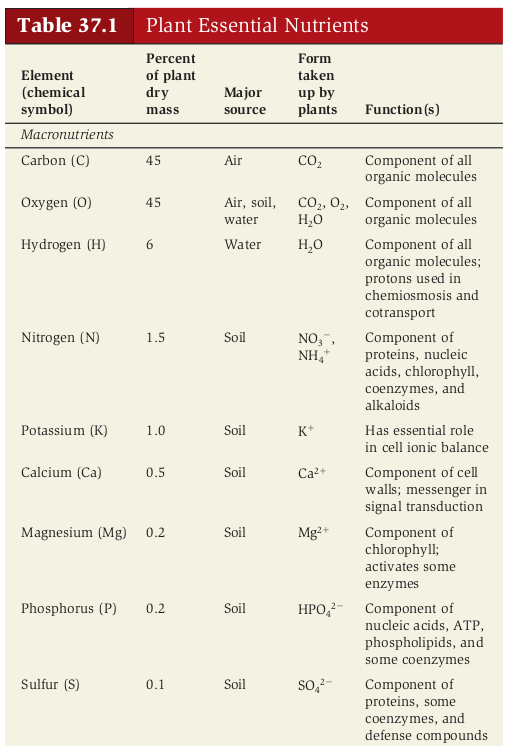
### Essential elements

- Play many roles in plant metabolism
- often function as enzyme factors

### Macronutrients

- required in amounts of atleast 1g per 1kg of dry plant mass

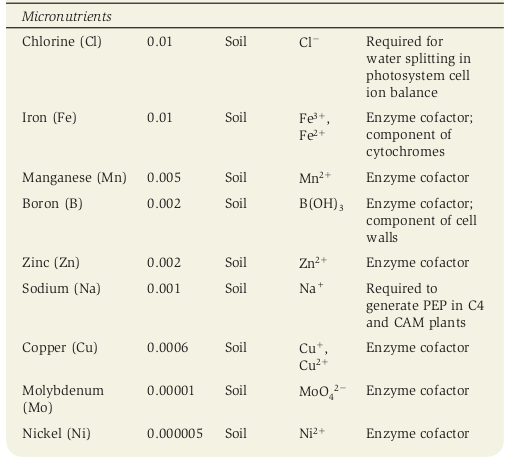
### Micronutrients

- trace elements
- required in amounts at or less than 0.1g per 1kg of dry plant mass

### Limiting factors

- resources that can limit plant growth 
    - too little or too much
- carbon dioxide
- water
- other mineral nutrients

<table border="1" id="bkmrk-" style="border-collapse: collapse; width: 100%;"><tbody><tr><td style="width: 50%;">[![Screenshot-from-2019-02-26-23-45-26.png](https://bookstack.aronwk.com/uploads/images/gallery/2019-02-Feb/scaled-840-0/64OuQGEfLO4KRmgW-Screenshot-from-2019-02-26-23-45-26.png)](https://bookstack.aronwk.com/uploads/images/gallery/2019-02-Feb/64OuQGEfLO4KRmgW-Screenshot-from-2019-02-26-23-45-26.png)</td><td style="width: 50%;">[![Screenshot-from-2019-02-26-23-45-39.png](https://bookstack.aronwk.com/uploads/images/gallery/2019-02-Feb/scaled-840-0/lU4W1Yqu4JqaVZCC-Screenshot-from-2019-02-26-23-45-39.png)](https://bookstack.aronwk.com/uploads/images/gallery/2019-02-Feb/lU4W1Yqu4JqaVZCC-Screenshot-from-2019-02-26-23-45-39.png)</td></tr></tbody></table>

# Chapter 38

## Transport of materials in plants

- Root system absorbs water and dissolved minerals from the soil
- Shoot system takes CO2 from the atmosphere via stomata
- Photosynthetic cells use these materials to produce organic compounds needed for growth and reproduction
- long-distance transportation occurs withing the plant body using a continuous system of conducting materials 
    - Xylem 
        - transport water and dissolved minerals
        - Only goes up
    - Phloem 
        - transports food and other solutes (hormones)
        - Goes up and down

[![Screenshot-from-2019-02-27-18-14-30.png](https://bookstack.aronwk.com/uploads/images/gallery/2019-02-Feb/scaled-840-0/DshAG72dEMyIUHb8-Screenshot-from-2019-02-27-18-14-30.png)](https://bookstack.aronwk.com/uploads/images/gallery/2019-02-Feb/DshAG72dEMyIUHb8-Screenshot-from-2019-02-27-18-14-30.png)

## Importance of water

- Photosynthesis
- support of plant organs
- conduction
- cell elongation
- most chemical reactions
- Average plant is 90% water
- Solvent for most substances 
    - Solution 
        - Solvent
        - Solute

### Properties of water

- Polar molecule 
    - neutral
- Hydrogen bonding
- Cohesiveness
- Adhesiveness
- Temperature Stabilizer
- Transport medium
- Best biological solvent
- Occurs in all 3 forms of matter within earth's temperature range

## Principles of movement

- Bulk\\Mass flow 
    - Mass movement of liquid cause by pressure and\\or gravity
    - Ex: leaching 
        - movement of ion though soil to plant roots
    - Faster than diffusion
- Diffusion 
    - high concentration &gt; low concentration
    - Simple diffusion 
        - Movement of molecules through a phospholipid bilayer down a concentration gradient
    - Facilitated Diffusion 
        - transport of molecules across a plasma membrane down a concentration gradient with the aid of membrane protiens
- Osmosis"gatekeeper" 
    - Diffusion across a selectively permeable membrane in response differences in solute concentration
    - simple diffusion of water does not occur rapidly enough for rapid expansion of plant cells
    - Aquaporins 
        - protein channels that allow facilitated diffusion of water

### Tissue-level transport

- trans-membrane transport 
    - export of material via membrane proteins, followed by import of the same substance by an adjacent cell
    - Ex. Auxin transport aided by carrier protiens
- Symplastic Transport 
    - Movement from cytosol of one cell to cytosol of another cell via plasmodesmata 
        - Cytosol 
            - Everything inside the cell wall
- Apoplastic transport 
    - movement along cell walls and inter-cellular spaces
    - Ex: water and disolved minerals

## Cellular water content

- water content of plant cells depends on osmosis, which depends on: 
    - Solute concentration
    - Turgor preassure 
        - hydrostatic pressure that increases as water enters plant cells
        - cell walls restrict the extent to which the cells can swell

[![1280px-Turgor_pressure_on_plant_cells_diagram.svg.png](https://bookstack.aronwk.com/uploads/images/gallery/2019-02-Feb/scaled-840-0/DOm5yzfVEpxRxuqu-1280px-Turgor_pressure_on_plant_cells_diagram.svg.png)](https://bookstack.aronwk.com/uploads/images/gallery/2019-02-Feb/DOm5yzfVEpxRxuqu-1280px-Turgor_pressure_on_plant_cells_diagram.svg.png)

- - Turgid plant cell has cytosol full of water and plasma membrane pushes up against the cell wall
    - Plasmolyzed cell has lost so much water that turgor pressure is lost and the plasma membrane no longer presses on the cell wall

## Water potential

- Potential energy of water
- Water moves from highest to lowest water potential 
    - affected by 
        - pressure
        - solute concentration
        - other factors (damage, temperature)
- Concept used in 2 ways 
    - to understand the movement of water into and out of cells (cellular water potential)
    - to understand the movement of water between entire plants and their enviroments

## Water (and soil mineral) movement through the plant

- Transpiration 
    - Evaporation of water from plant surfaces
    - "cost" for the plant to live on land
    - capable of pulling water up by bulk flow
    - primary form of long distance water transportation in plants

[![schematic_gas_exchange_across.png](https://bookstack.aronwk.com/uploads/images/gallery/2019-02-Feb/scaled-840-0/Sn4bFqEygOIzvHXk-schematic_gas_exchange_across.png)](https://bookstack.aronwk.com/uploads/images/gallery/2019-02-Feb/Sn4bFqEygOIzvHXk-schematic_gas_exchange_across.png)

- Stomata 
    - Opening has 2 guard cells 
        - control balance of CO2, O2, and H2O inside leaf

### Xylem

- Flowering plant xylem consists of 4 types of cells

1. Xylem parenchyma cells
2. Thick-walled supportive fibers 
    - may be alive or dead at maturity
3. vessel elements 
    - Speacilized water conducting cells and are always dead and empty of cytosol when mature
    - Wide tubes
4. Tracheids 
    - tracheory elements 
        - Rich in lignin which offers strength, durability, and water proofing
    - Narrow tubes

### Stomata

- Plants produce a waxy cuticle to prevent water loss
- stomata facilitate gas exchange
- 90% of water that evaporates from plants is lost through stomata
- when stomata are open, O2 and water vapor are released and CO2 is taken up
- controlled by guard cell pairs

[![Screenshot-from-2019-02-27-19-21-30.png](https://bookstack.aronwk.com/uploads/images/gallery/2019-02-Feb/scaled-840-0/2Vw3n8aLnp0cELoS-Screenshot-from-2019-02-27-19-21-30.png)](https://bookstack.aronwk.com/uploads/images/gallery/2019-02-Feb/2Vw3n8aLnp0cELoS-Screenshot-from-2019-02-27-19-21-30.png)

#### Mechanisms of Guard cells

- Daytime/sunlight 
    - CO2 is low in leaf
- Guard cells "pump" in K (potassium) 
    - Changes solute concentration
- H2O from xylem moves by osmosis onto guard cells 
    - cells become turgid
- Guard cells swell and open stomata 
    - CO2 diffusion into leaf
- "Pump" out K (potassium) 
    - H2O moves out by osmosis out of guard cells causing shrinking

- Pumping 
    - Expenditure of ATP energy

### Causes of water loss

- Sunlight energy 
    - heats up leaf causing evaporating of H2O from mesophyll cells
    - Causes a decrease in H2O concentration causing a "pull" of H2O
    - This "pull" moves H2O though the "Transpiration stream"

#### Transpiration Stream

- Soil H2O (and nutrients)
- root epidermis
- root cortex
- endodermis
- root xylem
- stem xylem
- leaf xylem
- mesophyll
- Vapor into atmosphere

Unidirectional movement  
Only goes UP!

#### C-A-T Mechanism

- Occurs once the stomata are open
- Purely a physical process
- "pull" of H2O one molecule at a time
- unidirectional movement
- **C**ohesion 
    - H2O molecules stick together
- **A**dhesion 
    - H2O adheres to cellulose in cell walls
- **T**ension 
    - "pull" due to H2O loss from mesophyll
- NO ENERGY expended
- Only energy is sunlight heating leaf

## Solute movement in plants

- Translocation 
    - movement of solutes in plants
- food 
    - dissolved in H2O
    - Moved in form of Sucrose
- Goes form Source to Sink 
    - Site with excess of carbohydrate
    - Site where the carbohydrate is stored or immediately needed
- Bidirectional

### Long-distance transport in phloem

- Phloem transports sugars from where they are produced and\\or stored to other sites where they are stored and/or needed 
    - Source &gt; Sink
- Primary Phloem 
    - Occurs in the vascular bundles of herbaceous plants
- Secondary Phloem 
    - Occurs as the inner bark of woody plants

### Phloem Structure

- Phloem of flowering plants in composed of **supporting fibers**, **parenchyma cells**, **sieve-tube elements**, and **adjacent companion cells (members)**
- Sieve-tube members (STM) are arranged end-to-end , and together with companion cells, form a system to transport soluble organic substances 
    - Sieve-tube members lose their nucleus and most of the cytoplasm to reduce obstruction to bulk flow
    - phloem sap passes through sieve plate pores

[![Screenshot-from-2019-02-27-19-58-17.png](https://bookstack.aronwk.com/uploads/images/gallery/2019-02-Feb/scaled-840-0/ix1uZ2m942od7BE6-Screenshot-from-2019-02-27-19-58-17.png)](https://bookstack.aronwk.com/uploads/images/gallery/2019-02-Feb/ix1uZ2m942od7BE6-Screenshot-from-2019-02-27-19-58-17.png)

[![Screenshot-from-2019-02-27-19-58-27.png](https://bookstack.aronwk.com/uploads/images/gallery/2019-02-Feb/scaled-840-0/XtH8sKXugg4zutpv-Screenshot-from-2019-02-27-19-58-27.png)](https://bookstack.aronwk.com/uploads/images/gallery/2019-02-Feb/XtH8sKXugg4zutpv-Screenshot-from-2019-02-27-19-58-27.png)

#### Pressure Flow Hypothesis

##### At source

1. Companion cells "pump" sucrose into STM (STP expended)
2. As sucrose concentration increases in STM, water potential (concentration) decreases within STM
3. Adjacent Xylem has higher water potential than STM, H2O moves into STM by osmosis

Bulk flow of Sucrose  
Higher Pressure &gt; lower Pressure

##### At sink

1. Companion cells unload sucrose (ATP expended)
2. Sucrose converted into starch for storage in root cortex
3. Without sucrose, higher H2O potential in STM
4. H2O moves from STM to adjacent Xylem by osmosis

[![Screenshot-from-2019-02-27-19-58-44.png](https://bookstack.aronwk.com/uploads/images/gallery/2019-02-Feb/scaled-840-0/CBI6gxoEwuZ3u7k7-Screenshot-from-2019-02-27-19-58-44.png)](https://bookstack.aronwk.com/uploads/images/gallery/2019-02-Feb/CBI6gxoEwuZ3u7k7-Screenshot-from-2019-02-27-19-58-44.png)

- ATP spent only by companion cells at source (loading) and sink (unloading)
- Bulk flow (pressure/potential differences) and osmosis (H2O potential\\concentration differences) 
    - No energy Expended

## Similarities Between Translocation and Transpiration

- Both involve conduction
- both involve physical properties of H2O

<table border="1" id="bkmrk-translocation-transp" style="border-collapse: collapse; width: 77.5195%;"><tbody><tr><td class="align-center" style="width: 36.1166%;">Translocation</td><td class="align-center" style="width: 41.2111%;">Transpiration</td></tr><tr><td style="width: 36.1166%;">- Phloem
- Bidirectional
- Must expend ATP energy by plant

</td><td style="width: 41.2111%;">- Xylem
- Unidirectional
- Sunlight energy (no expenditure by plant)

</td></tr></tbody></table>

# Chapter 39

## Reproduction in plants

- Most flowering plants display sexual reproduction 
    - Two gametes fuse to produce offspring with a unique combination of genes
- They undergo <span style="text-decoration: underline;">Alternation of Generations</span>
    - Two multicellular life cycle stages
    - diploid 
        - Spore producing sporophyte 
            - produces spores by meiosis 
                - a type of cell division that results in four daughter cells each with half the number of chromosomes of the parent cell, as in the production of gametes and plant spores.
    - haploid 
        - Gamete producing gametophyte 
            - produces gametes by mitosis 
                - a type of cell division that results in two daughter cells each having the same number and kind of chromosomes as the parent nucleus, typical of ordinary tissue growth.
- Egg is Female
- Sperm is Male

[![Screenshot-from-2019-02-27-20-43-03.png](https://bookstack.aronwk.com/uploads/images/gallery/2019-02-Feb/scaled-840-0/UaSqYxHWtFy7Qc4C-Screenshot-from-2019-02-27-20-43-03.png)](https://bookstack.aronwk.com/uploads/images/gallery/2019-02-Feb/UaSqYxHWtFy7Qc4C-Screenshot-from-2019-02-27-20-43-03.png)

## Evolutionary Trends in the Plant Kingdom

- Sporophyte has become larger, more complex 
    - Flowering plants 
        - Sporophyte independent
        - Dependent gametophyte is only a few cells contained within flowers
- Gametophyte has become smaller, less complex 
    - Moss 
        - Sporophytes small and dependent on gametohyte (Dominant form)
- Female 
    - 7 cells
- Male 
    - 2-3 cells

[![Screenshot-from-2019-02-27-20-48-43.png](https://bookstack.aronwk.com/uploads/images/gallery/2019-02-Feb/scaled-840-0/kCPmVzrJKv2neXNG-Screenshot-from-2019-02-27-20-48-43.png)](https://bookstack.aronwk.com/uploads/images/gallery/2019-02-Feb/kCPmVzrJKv2neXNG-Screenshot-from-2019-02-27-20-48-43.png)

## Flower and Sexual Cycle

- Flowers 
    - ONLY in angiosperms
    - All sizes, shapes, colors, and aromas
- Essential process of Sexual reproduction occurs within flowers 
    - Meiosis/cytokenesis 
        - reduces chromosome number
    - Syngamy (fertilization) 
        - restores chromosome number

## "Ideal" Flower

- Uses highly modified leaves arranged in whorls (circular) at the tip of a highly modified stem
- A flower is a highly modified determinate (short term) shoot system

[![Screenshot-from-2019-02-27-21-31-46.png](https://bookstack.aronwk.com/uploads/images/gallery/2019-02-Feb/scaled-840-0/6gx5mlE0Jyvaj1nE-Screenshot-from-2019-02-27-21-31-46.png)](https://bookstack.aronwk.com/uploads/images/gallery/2019-02-Feb/6gx5mlE0Jyvaj1nE-Screenshot-from-2019-02-27-21-31-46.png)

- Pedical, receptical, 4 sets of highly modified leaves are all 2N and part of the sporophyte generation
- Pollen (sperm) and eggs of embryo sac are part of the 1N generation
- Pedical 
    - flower stalk
- Recepticle 
    - tip of modified stem with 4 whorls attached

## Sexual Cycle

[![Screenshot-from-2019-02-27-21-34-37.png](https://bookstack.aronwk.com/uploads/images/gallery/2019-02-Feb/scaled-840-0/jdK9UFdS3EQL8wjb-Screenshot-from-2019-02-27-21-34-37.png)](https://bookstack.aronwk.com/uploads/images/gallery/2019-02-Feb/jdK9UFdS3EQL8wjb-Screenshot-from-2019-02-27-21-34-37.png)

[![Screenshot-from-2019-02-27-21-37-45.png](https://bookstack.aronwk.com/uploads/images/gallery/2019-02-Feb/scaled-840-0/rWpi8vuGXj6WiaVB-Screenshot-from-2019-02-27-21-37-45.png)](https://bookstack.aronwk.com/uploads/images/gallery/2019-02-Feb/rWpi8vuGXj6WiaVB-Screenshot-from-2019-02-27-21-37-45.png)

### Male

- Pollen formation 
    - occurs within the anther of stamen
- Anther 
    - Bilobed with 2 pollen chambers per lobe

[![922bc112d7d7f455d12aa057c7c9ce47.jpg](https://bookstack.aronwk.com/uploads/images/gallery/2019-02-Feb/scaled-840-0/W4kDUsmWtcjg6NN2-922bc112d7d7f455d12aa057c7c9ce47.jpg)](https://bookstack.aronwk.com/uploads/images/gallery/2019-02-Feb/W4kDUsmWtcjg6NN2-922bc112d7d7f455d12aa057c7c9ce47.jpg)

1. 2N microspore mother cell
2. meiosis/cytokenesis
3. 4 1N microspores
4. Each: mitosis/cytokenesis  
    unequal and incomplete
5. 1N Generating cell  
    1N Tubecell

Male Gametophyte

[![Screenshot-from-2019-02-27-22-15-33.png](https://bookstack.aronwk.com/uploads/images/gallery/2019-02-Feb/scaled-840-0/wClGUK8ETPCxCDl3-Screenshot-from-2019-02-27-22-15-33.png)](https://bookstack.aronwk.com/uploads/images/gallery/2019-02-Feb/wClGUK8ETPCxCDl3-Screenshot-from-2019-02-27-22-15-33.png)

#### Pollination

- Transfer of pollen from the anther to the stigma
- Self-pollination 
    - Transfer with the same flower or between flowers on the <span style="text-decoration: underline;">same plant</span>  
        
        - - - - - - - - - - - - - - - - - - - - - - - - - - - - - -
- Cross-Pollination 
    - Transfer between flowers of other plants

##### Pollinating Agents

Mechanisms utilized for transfer of pollen

1. Wind 
    - small/lightweight pollen
2. Water 
    - Transfer with a few aquatic plants
3. Animals 
    - Majority of plants
    - Utilized as a "trick and reward" system
    - nectar, colors, and aromas to attract animals

### Female

Ovule Development

- Ovule 
    - future seed
- Enclosed within the ovary of pistol (carpel)
- One to many ovules per ovary 
    - ovary will become fruit
- Ovule attached to central axis or to wall of hollow fruit 
    - always enclosed
    - angiosperms
- within ovule is 1 large 2N cell 
    - megaspore mother cell

[![20190227_222436.jpg](https://bookstack.aronwk.com/uploads/images/gallery/2019-02-Feb/scaled-840-0/nFInSj1sgaU98zAk-20190227_222436.jpg)](https://bookstack.aronwk.com/uploads/images/gallery/2019-02-Feb/nFInSj1sgaU98zAk-20190227_222436.jpg)

1. 2N megaspore mother cell
2. meisos/sytokenesis
3. 4 1N Megaspores
4. 3 degrade
5. 2N Functional megaspore
6. Series of 3 mitosis/cytokenesis cycles  
    Incomplete and unqueal
7. 7-celled embryo sac  
    8 nuclei

Female gametophyte

[![embryo-sac.gif](https://bookstack.aronwk.com/uploads/images/gallery/2019-02-Feb/U0gQuMvC2mrSvdDK-embryo-sac.gif)](https://bookstack.aronwk.com/uploads/images/gallery/2019-02-Feb/U0gQuMvC2mrSvdDK-embryo-sac.gif)

[![Screenshot-from-2019-02-27-22-15-55.png](https://bookstack.aronwk.com/uploads/images/gallery/2019-02-Feb/scaled-840-0/iWWVysmvIq1CzhVd-Screenshot-from-2019-02-27-22-15-55.png)](https://bookstack.aronwk.com/uploads/images/gallery/2019-02-Feb/iWWVysmvIq1CzhVd-Screenshot-from-2019-02-27-22-15-55.png)

- 1N Functional megaspore 
    - 3 mitosis/cytokenesis divisions
- One cell with 1 nucleus becomes 8 nuclei but only 7 cells

#### Embryo sac

- 8 nuclei, 7 cell structure
- female gametophyte
- 3 antipodal cells (1N) 
    - opposite end from micropyle
- 1 central cell with 2 large 1N polar nuclei
- 2 Synergids (1N) 
    - Micropyle end on outside
- 1 egg (1N) 
    - Middle at micropyle end

### Syngamy (fused gametes)

- 1N egg + 1N sperm = 2N zygote (single fertilized egg)
- Pollen grain germination 
    - tube cells form pollen tube (delivers sperm)
    - generative cell divides by mitosis/cytokenesis to produce 2 sperm

[![Screenshot-from-2019-02-27-22-45-54.png](https://bookstack.aronwk.com/uploads/images/gallery/2019-02-Feb/scaled-840-0/vL8i78rPOWMcXIqI-Screenshot-from-2019-02-27-22-45-54.png)](https://bookstack.aronwk.com/uploads/images/gallery/2019-02-Feb/vL8i78rPOWMcXIqI-Screenshot-from-2019-02-27-22-45-54.png)

- Pollen tube enters micropyle 
    - digests tube cell nucleus
- Pollen tube enters one synergid 
    - releases it's content (sperm)
    - synergid ruptures
    - mycropyle closes

- "Double fertilization" (double fusion) 
    - 1N egg +1N sperm = 2N zygote
    - 1N sperm +2 1N polar nuclei = 3N primary endosperm cell

- Post fertilization with ovule
- 2N zygote grows by mitosis/cytokenesis into 2N multicellular embryo
- 3N primary endosperm cell grows by mitosis/cytokenesis into 3N multicellular endosperm 
    - nutrient tissue for embryo

- Ovule/ovary with 2N zygote mature/enlarges with sugars/H2O into a fruit (mature ovary) with enclosed seeds (mature ovules)
- Seed dispersal (seeds enclosed withing a fruit)
- agents 
    - wind
    - water
    - animals - majority

## Seed germination

- Seed with 2N embryo enters period of dormancy
- dormancy broken by a combination of internal (hormones) and external factors (environmental)
- radical (first root) emerges and grows down
- shoot emerges and grows up