# Biology II

# Syllabus

See attached

Doesn't copy/paste well at all.......

# Lab Notes

# Lab 12

# Exam 1 - Notes

# Chapter 26

## Overview

- Taxonomy and Systematics
- Phylogenetic Trees
- Horizontal Gene Transfer

### Taxonomy

The Science of describing, naming, and classifying living an extinct organisms and viruses.

#### Systematics

Study of biological diversity and the evolutionary relationships among organisms, both extinct and modern.

- Taxonomic groups are based on hypothesis regarding evolutionary relationships from systematics
- Hierarchical system involving successive levels
- Each group at any level is called a **taxon**
- Highest level is **Domain**
    - All life belongs to 3 domains
    - Bacteria, Archaea, and Eukarya 
        - The Eukarya Domain is often divided into Kingdoms in the next level  
            This is typically called the 4 Kingdom concept

[![Screenshot-from-2019-01-29-11-51-38.png](https://bookstack.aronwk.com/uploads/images/gallery/2019-01-Jan/scaled-840-0/WkMUYtKa68gITVpG-Screenshot-from-2019-01-29-11-51-38.png)](https://bookstack.aronwk.com/uploads/images/gallery/2019-01-Jan/WkMUYtKa68gITVpG-Screenshot-from-2019-01-29-11-51-38.png)

## Four Kingdoms

- Domains Bacteria and Archaea 
    - Prokaryotic cells 
        - Lack nucleus
- Kingdom Protista, Fungi, Plantae, Animilia 
    - Eukaryotic cells 
        - True nucleus

### Types of cells

#### Prokaryotic 

- Lack Nucleus
- Lacks membrane-bound organelles
- Typically singled celled

#### Eukaryotic 

- Well defined nucleus
- Membrane-bound organelles
- internal membrane system (compartments)

## Binomial Nomenclature

- Genus name + Specific epithet 
    - ex. *Homo sapiens* ('wise humans')
- Genus name is always capitalized
- Specific epithet is never capitalized
- Both names are either *italicized* or <span style="text-decoration: underline;">underlined</span>

## Phylogenetic Trees

- Phylogeny 
    - Evolutionary history of a species or group of species
- To propose a phylogeny, biologist must use the tools of **systematics**
- Trees are usually based in morphological and genetic data 
    - Subjective vs. Objective data
- Diagram that describes the phylogeny
- A hypothesis of evolutionary relationships among various species
- Based on available information

#### Monophyletic Group or Clade

- Group of species (taxon) consisting of the most recent ancestor and all of its descendants
- Smaller and more recent clades are nested within larger clades that have a common ancestor

#### Paraphyletic group

- Contains a common ancestor and some, but not all of its descendants

[![Screenshot-from-2019-01-29-11-52-15.png](https://bookstack.aronwk.com/uploads/images/gallery/2019-01-Jan/scaled-840-0/m2Obq2j58FU3mZ4U-Screenshot-from-2019-01-29-11-52-15.png)](https://bookstack.aronwk.com/uploads/images/gallery/2019-01-Jan/m2Obq2j58FU3mZ4U-Screenshot-from-2019-01-29-11-52-15.png)

- Over time, taxonomic groups will be reorganized so that only monophyletic are recognized
- Reptiles were a paraphyletic group because birds were excluded
- **In the class and lab, we are going to separate birds and reptiles**

[![Screenshot-from-2019-01-29-11-53-44.png](https://bookstack.aronwk.com/uploads/images/gallery/2019-01-Jan/scaled-840-0/8Wv6XVyvrUgZQDcl-Screenshot-from-2019-01-29-11-53-44.png)](https://bookstack.aronwk.com/uploads/images/gallery/2019-01-Jan/8Wv6XVyvrUgZQDcl-Screenshot-from-2019-01-29-11-53-44.png)

## Systematics

### Morphological Analysis

- First systematic studies focused on morphological features of extinct and modern species
- Most of early classifications were based upon morphological features

### Molecular Analysis

- Analysis of genetic data (DNA, Amino Acids, rRNA) to identify and study genetic similarities and propose phylogentic trees
- DNA and Amino Acid sequences from closely related species are more similar to each other than sequences from more distantly related species

### Horizontal Gene Transfer

- any process in which an organism incorporates genetic material from another organism without being the offspring of that organism (by means of asexual reproduction)

### Vertical Evolution

- Changes in groups due to descent form a common ancestor (sexual reproduction)

# Chapter 27-31

## Prokaryotic Diversity

- Prokaryotes dated at 3.5 billion years old
- Modern Prokaryotes are most abundant, lacking sexual reproduction

### Domain Bacteria

- Proteobacteria 
    - "true bacteria"
- Cyanobacteria 
    - "Blue-Green bacteria"

### Domain Archaea

- Have and "almost" nucleus
- specialized membranes
- surrounded by a cell wall
- old, can live in extreme conditions

## Eukaryotic Diversity (Ch 28)

## Kingdom Protista

- Earliest eukaryotes in fossil record
- most are microscopic and found in moist environments
- DNA many separate groups
- Most artificial category 
    - "catch-all" category

### Subgroups

#### Algae

- Plant-like organisms
- 10 groups
- autotrophic (self-feeding) 
    - most are photosynthetic
    - few ingest food
- cell wall with

#### Protozoans

- Animal-like
- mostly netraothrophic (food-eating)

#### Slime Molds

- Fungal-like Protist
- Mostly saprothrophic (absorb-feeding)
- mostly multicellular

## Kingdom Fungi (Ch 31)

- Conspicuous portion of the organism in the mushroom/yeast/mold/etc
- Saprothrophic (some are heterotrophic)
- Natures recyclers
- Composed of: 
    - Mycelium 
        - compacted mass of tubular filaments called hyphae
    - Fruiting body 
        - site of spore production
    - Cell wall 
        - composed of muramic acid/chitin

## Kingdom Plantae (Ch 29 &amp; 30)

- &gt;330,000 species
- eukaryotic and multicellular
- autotrophic (mostly) self-feeding 
    - capture sunlight to produce energy by photosynthesis
    - Food storage copound 
        - starch
    - cell wall 
        - cellulose
- Are referred to as "land plants"
- fossils dated to ~400mybp (million years before present)
- Ancestor stock 
    - probably a group of algae (green)
- Life on land requires special innovation 
    - Must be able to get water 
        - ROOTS!

### Phyla (divisions)

- 10 phyla
- Typically combine these into 4 broad categories for convenience

#### Bryophytes

- Phylum Hepatophyta 
    - Liverworts
    - ~6500 species
- Phylum Anthocerophyta 
    - Hornwarts
    - ~100 species
- Phylum Bryophyta 
    - Mosses
    - ~12,000 species

Referred to as "mosses and their friends"

##### Characteristics

- Reproduce by spores (not seeds)
- non-vascular plants 
    - lack conducting tissues 
        - xlem and phloem
- Small plants
- Require external H2O for reproduction

#### Pteridophytes

- Phylum Lycopodiophyta 
    - lychophytes
    - 1000 species
- Phylum Pteridophyts 
    - Ferns and allies
    - 12,000 species

##### Characteristics

- Sporangia 
    - Where the spores are produce
- Reproduce by spores 
    - no seeds
- vascular plants 
    - xylem 
        - water and minerals
    - phloem 
        - food and solutes
- true roots, stem, and leaves 
    - due to being vascular
- vascular allows for larger size
- Require external H2O for reproduction

#### Gymnosperms

- Phylum Cycadophyta 
    - cycads
    - 300 species
- Phylum Ginkophyta 
    - Ginko
    - 1 species
- Phylum Gnetophyta 
    - gnetophytes
    - 300 species
- Phylum Coniferophytes 
    - conifers
    - 500 species

Means "Naked seeds"  
Seeds are not enclosed

Biggest group are the conifers  
(Cone bearing trees)

- Oldest 
    - Bristle cone pine 
        - Over 4600 years
- Biggest 
    - Giant Sequoia 
        - estimated 600 tons
- Tallest 
    - Coastal Redwood
    - 180 meters in height

##### Characteristics

- Vascular 
    - more advanced that Pteridophytes
- Advance seed 
    - It has more survival value
    - Contains: 
        - Embryo 
            - Offspring
        - Stored food
        - Integument 
            - Seed coating
- Does not require external H2O for reproduction 
    - Pollen tubes deliver sperm to egg location

#### Angiosperms

- Phylum Anthophyta 
    - 300,000 species

##### Characteristics

- Enclosed seed
- produces flowers and fruits
- most advance vascular tissues
- Seeds advance 
    - Enclosed in a vesses (fruit) 
        - no survival value
    - Embryo
    - Stored food
    - 2 integuments 
        - Seed coats
- Does not require external H2O for reproduction
- Flowers 
    - Attract pollinators
- Fruit 
    - Enclose and protect the seed
    - assist with seed dispersal

# Chapter 32 & 33

## Kingdom Animilia

- Over 1.5 million species 
    - Estimated 73 million
- 35 Phylums 
    - Over half are insects
- More similarities within animal genomes than other kingdoms

### Characteristics 

- Multicellular
- Lack of cell wall
- Sexual reproduction 
    - mobile sperm
    - larger non-motile egg
- Nervous Tissue 
    - Complexity
    - Responsiveness
- Hox Genes 
    - Special clusters of genes associated with the planning of the body

[![Screenshot-from-2019-01-29-12-00-54.png](https://bookstack.aronwk.com/uploads/images/gallery/2019-01-Jan/scaled-840-0/7svEQ3Ey5pguUaDH-Screenshot-from-2019-01-29-12-00-54.png)](https://bookstack.aronwk.com/uploads/images/gallery/2019-01-Jan/7svEQ3Ey5pguUaDH-Screenshot-from-2019-01-29-12-00-54.png)

[![Screenshot-from-2019-01-29-12-01-51.png](https://bookstack.aronwk.com/uploads/images/gallery/2019-01-Jan/scaled-840-0/n9phZd3dW5Xva89B-Screenshot-from-2019-01-29-12-01-51.png)](https://bookstack.aronwk.com/uploads/images/gallery/2019-01-Jan/n9phZd3dW5Xva89B-Screenshot-from-2019-01-29-12-01-51.png)

### Metazoans

- All animals
- Multicellular animals
- Paratoans 
    - Sponges
- Eumetazoans 
    - "true" multicellular animals

### Classification/Systematics

- Old 
    - Morphology
    - Embryonic Development
- Recent 
    - Molecular genetics

### Body Plans

Morphological and Developmental Features

1. Body Symmetry
2. Number of tissue Layers
3. Patterns of Embryonic development

#### Symmetry

- Eumetazoa 
    - Divided by symmetry
- Radiata 
    - Radial symmetry
    - Often Circular or tubular
- Bilateria 
    - Bilateral symmetry
    - Dorsal 
        - Back
    - Ventral 
        - Front
    - Anterior
    - Posterior
    - cephalization 
        - enlarged head

[![Screenshot-from-2019-01-29-12-02-37.png](https://bookstack.aronwk.com/uploads/images/gallery/2019-01-Jan/scaled-840-0/uWhuBNwMH0OUgRwt-Screenshot-from-2019-01-29-12-02-37.png)](https://bookstack.aronwk.com/uploads/images/gallery/2019-01-Jan/uWhuBNwMH0OUgRwt-Screenshot-from-2019-01-29-12-02-37.png)

#### Tissues

- Metazoa 
    - all animals
    - divided on weather or not they have specialized tissues
- Parazoa 
    - Porfera 
        - sponges
        - may have distinct cell types
- Enmetazoa 
    - more than one type of tissue
    - organs
    - all other animals

##### Germ Layers

- Radial 
    - 2 layers
    - Diploblastic 
        - endoderm
        - ectoderm
- Bilateral 
    - 3 layers
    - Triploblastic 
        - endoderm
        - ectoderm
        - mesoderm

[![Screenshot-from-2019-01-29-12-03-02.png](https://bookstack.aronwk.com/uploads/images/gallery/2019-01-Jan/scaled-840-0/TFAhXfNlpGDLXT1R-Screenshot-from-2019-01-29-12-03-02.png)](https://bookstack.aronwk.com/uploads/images/gallery/2019-01-Jan/TFAhXfNlpGDLXT1R-Screenshot-from-2019-01-29-12-03-02.png)

##### Embryonic Development

- Protostome 
    - Blastopore becomes mouth
    - cleavage is determinate 
        - fate of embryonic cells are determined early
- Deuterostome (second opening) 
    - Blastopore becomes anus
    - cleavage is indeterminate
    - each cell produced by early cleavage can develop into a complete embryo

##### Other Morphological Characteristics

Used in classification

- Presence or absence or coelom
- Body segmentation

Molecular data suggest these features are unreliable in terms of understanding evolutionary history

##### Body Cavity

Coelom

- - a fluid-filled body cavity
- Coelomate or eucolemate 
    - true coelom
    - coelom completely lined with mesoderm
- Pseudocoelom 
    - coelom only partially lined with mesoderm
    - rotifers and roundworms
- Acoelomate 
    - lack of a body cavity and instead have mesenchyme
    - flatworms

[![Screenshot-from-2019-01-29-11-49-49.png](https://bookstack.aronwk.com/uploads/images/gallery/2019-01-Jan/scaled-840-0/Ll8Gw0R3zNLygxCm-Screenshot-from-2019-01-29-11-49-49.png)](https://bookstack.aronwk.com/uploads/images/gallery/2019-01-Jan/Ll8Gw0R3zNLygxCm-Screenshot-from-2019-01-29-11-49-49.png)

Flatworm has no mesoderm

Functions of the Coelom

- Cushions internal organs
- Enables movements and growth of internal organs independent of the body wall
- Fluid acts as a simple circulatory system

Segmentation

- Body may be divided into regions called segments
- occurs in annelid worms, arthropods, and chordates
- allows specialization of body region

[![Screenshot-from-2019-01-29-11-48-35.png](https://bookstack.aronwk.com/uploads/images/gallery/2019-01-Jan/scaled-840-0/8QttkWqKBKBu56Iy-Screenshot-from-2019-01-29-11-48-35.png)](https://bookstack.aronwk.com/uploads/images/gallery/2019-01-Jan/8QttkWqKBKBu56Iy-Screenshot-from-2019-01-29-11-48-35.png)

DO NOT worry about the number of species

## Molecular views of Animal Diversity

- Scientist now use molecular techniques to classify animals 
    - Compare similarities in DNA, rRNA, and Amino Acids
    - Closely related organisms have fewer differences than those more distantly related
- Advantages over morphological data in that genetic sequences are easier to quantify and compare 
    - Example: A,T,G, and C in DNA

### Genes used in Molecular Systematics

- Studies often focus on ribosomal RNA (rRNA) 
    - Universal in all organisms
    - changes slowly over time
- Hox genes also studied often 
    - Found in all animals
    - duplications in these genes may have led to evolution of body form
- Phylogenies constructed using rRNA and Hox genes are similar and often agree with those based on morphology

## Invertebrates

- "without backbone"
- +95% of all species

### Phylum Porifera

- Sponges
- lack tissues (organs)
- multicellular
- pores 
    - filter H2O and food
- Invertebrates

### Phylum Cnidaria

- Jelly fish, corals, anemones
- Diploblastic development 
    - Two tissue layers
- Mesoclea 
    - gelatinous covering
- Nerve net 
    - interconnected nerve cells
    - no brain
- One opening with gastrovascular cavity
- Protostomes
- Invertebrates
- Radial symmetry
- Salt and fresh water
- Stingers

### Phylum Ctenophora

- Comb jellies
- Same characteristics as Cnidaria
- Strictly salt water
- No Stingers

### Phylum Platyhelminthes

- Flatworms, tapeworms, flukes
- Triploblastic
- Organs and organ systems
- Enhanced nerve net 
    - 2 cerebral ganglia
- One opening with gastrovascular cavity
- Protostomes
- invertebrates
- bilateral symmetry
- Acoelomate

### Phylum Rotifera

- rotifers
- pseudocoelomate
- Triploblastic
- Two openings 
    - complete gut tract
    - alimentary canal
- Protostomes
- Corona
- simple brain
- invertebrates

### Phylum Mollusea

- Snails, slugs, oysters, octopus, squid, clams, muscles
- Triploblastic
- Eucoelomate
- Complete gut tract
- Protostomes
- Invertebrates
- Three part Body 
    - Foot
    - Visceral mass
    - Mantle 
        - Many have outer shells

### Phylum Annelida

- Segmented ring worms
- Triploblastic
- Eucoelomate
- Complete gut tract
- Protostomes
- Enhanced nervous system
- Invertebrates

### Phylum Nematoda

- Roundworms
- Triploblastic
- Pseudocoelomate
- Complete gut tract
- Protostomes
- Invertebrates

### Phylum Anthropoda

- Insects, crustaceans, spiders, ticks
- Highest diversity of animals 
    - &gt;1.5 million species
- Hardened Exoskeleton
- Protostomes
- Invertebrates
- Eucoelomate
- Triploblastic
- Complete gut tract
- Enhanced nervous system 
    - Insects, in particular, have an enhanced brain
- segmented appendages

### Phylum Echinodermata

- sea stars, urchins, sea cucumbers, sand dollars
- Triploblastic
- Eucoelomate
- Complete gut tract
- Deuterostomes
- Simple nervous system
- Endoskeleton 
    - series of plates

## Phylum Chordata

- Deuterstomes
- Complete gut tract
- Endoskeleton
- Few invertebrates 
    - Mostly vertebrates
- Eucloemates
- Triploblastic

## Four Critical Innovations of Chordate Body Design

1. Notochord
2. Dorsal, hollow nerve cord
3. Pharyngeal gill pouches
4. Post-anal tail

- These four features are exhibited at some point of life history/development 
    - Only some Fishes exhibit all four

### Notochord

- Cartilaginous supporting rod along the dorsal axis
- Replaced by jointed "backbone" 
    - Vertebral column of hardened cartilage or bone

### Dorsal, hollow nerve cord

- Expanded at the anterior end 
    - Brian
- Enclosed/supported/protected by the Notochord

### Pharyngeal gill pouches

- Gill slits
- pharynx 
    - back of mouth cavity

### Post-anal Tail

- Tail extends posterior of the anus

#### Humans

##### Notochord

- replaced by vertebrae
- only pieces left are the inter-vertebral discs between vertebrae

##### Nerve cord

- Dorsal, hollow with largest brain capacity (compared to body size)

##### Pharyngeal Pouches

- Embryonic Development
- 1 pair retained as Eustachian tubes

##### Post-anal Tail

- One vertebra as a tail bone (coccyx)

### Subphylum Urochordata

- tunicates
- invertebrates
- ~3000 species
- Marine
- Filter feeders

[![Screenshot-from-2019-01-29-11-47-27.png](https://bookstack.aronwk.com/uploads/images/gallery/2019-01-Jan/scaled-840-0/inQ83f0n1DNhLdpF-Screenshot-from-2019-01-29-11-47-27.png)](https://bookstack.aronwk.com/uploads/images/gallery/2019-01-Jan/inQ83f0n1DNhLdpF-Screenshot-from-2019-01-29-11-47-27.png)

### Subphylum Cephalochordata

- Lancelets
- Invertebrates
- 25 species
- marine
- Filter feeders

[![Screenshot-from-2019-01-29-11-45-01.png](https://bookstack.aronwk.com/uploads/images/gallery/2019-01-Jan/scaled-840-0/Nuxg9xz3SwNgJgm8-Screenshot-from-2019-01-29-11-45-01.png)](https://bookstack.aronwk.com/uploads/images/gallery/2019-01-Jan/Nuxg9xz3SwNgJgm8-Screenshot-from-2019-01-29-11-45-01.png)

# Chapter 34

## Subphylum Vertebrata

- Vertebrates
- Chordates with a backbone

Chordate features as well as:

1. Vertebral column 
    - Series of cartilaginous or bony elements
2. Cranium
3. Endoskeleton or cartilage or bone
4. Hox genes (lots of them)
5. Neural crest

[![Screenshot-from-2019-01-29-11-59-40.png](https://bookstack.aronwk.com/uploads/images/gallery/2019-01-Jan/scaled-840-0/WnHIpkqEgDgAE0Qr-Screenshot-from-2019-01-29-11-59-40.png)](https://bookstack.aronwk.com/uploads/images/gallery/2019-01-Jan/WnHIpkqEgDgAE0Qr-Screenshot-from-2019-01-29-11-59-40.png)

[![Screenshot-from-2019-01-29-12-07-52.png](https://bookstack.aronwk.com/uploads/images/gallery/2019-01-Jan/scaled-840-0/HnAoBE4j1MFZmLVK-Screenshot-from-2019-01-29-12-07-52.png)](https://bookstack.aronwk.com/uploads/images/gallery/2019-01-Jan/HnAoBE4j1MFZmLVK-Screenshot-from-2019-01-29-12-07-52.png)

### Cyclostomes

- Jawless Fishes

#### Class Myxini

- Hagfishes
- lack jaws, eyes, fins vertebrae
- skeleton comprised of notochord and cartilaginous skull
- covered in slime

#### Class Cephalospidomorphi

- Lampreys
- Has notochord, and cartilaginous vertebral column
- lacks jaws and appendages (fins)
- Oldest fossil records 510 mybp

### Class Chondrichthyes

- Cartilaginous fishes
- Sharks, skates, rays
- Cartilaginous skeleton and notochord as adults
- jawed fishes
- paired appendages (fins)
- &lt; 900 species

### Class Osteichthyes

- Bony fishes
- Most diverse vertebrate group with &lt; 26,000 species
- Bony skeleton (most do have this)
- Jawed
- paired appendages (fins)

## Tertapod: Gnathastomes

- Four limbs with jawed mouth
- Transition to land involved adaptions for locomotion, reproduction, desiccation (drying out) prevention, and gas exchange
- Sturdy lobe-finned fishes became animals with four limbs
- Vertebral column strengthened, ship and shoulder bones braced against backbone
- relatively simple changes in gene expression, especially Hox genes

### Class Amphibia

- &gt;4000 species
- Amphibios 
    - greek - "living double life"
    - split their life between aquatic and terrestrial stages
- Successfully invaded land but reproduce in water
- Lunges are and adaption to semi-terrestrial lifestyle
- Three chambered heart 
    - Fishes only have a two chambered heart
- External Fertilization
- Larval stages are aquatic 
    - Undergo metamorphosis
- Not completely separated from water

[![Screenshot-from-2019-01-29-12-33-08.png](https://bookstack.aronwk.com/uploads/images/gallery/2019-01-Jan/scaled-840-0/SlypUH0QiIkh947E-Screenshot-from-2019-01-29-12-33-08.png)](https://bookstack.aronwk.com/uploads/images/gallery/2019-01-Jan/SlypUH0QiIkh947E-Screenshot-from-2019-01-29-12-33-08.png)

#### Order Anura

- Frogs and toads
- Nearly 90% of amphibians
- Carnivorous adults 
    - Herbivorous tadpoles

#### Order Apoda

- Caecilians
- Nearly blind tropical burrowers
- Secondarily legless

#### Order Urodela

- Salamanders
- Often have colorful skin patterns
- Most have four limbs

[![Screenshot-from-2019-01-29-12-33-21.png](https://bookstack.aronwk.com/uploads/images/gallery/2019-01-Jan/scaled-840-0/nX9GLgeq5Sx2Mdqq-Screenshot-from-2019-01-29-12-33-21.png)](https://bookstack.aronwk.com/uploads/images/gallery/2019-01-Jan/nX9GLgeq5Sx2Mdqq-Screenshot-from-2019-01-29-12-33-21.png)

## Amniotes

- Tetrapods with a desiccation resistant egg
- Critical innovation 
    - Development of a shelled egg
- Amniotic egg 
    - Broke the tie to water
    - Three internal membranes
- Shell is permeable to Oxygen and CO2 
    - Birds 
        - Hard and Calcareous
    - Reptiles 
        - Soft and Leathery
    - Most Mammals 
        - Embryo embeds in uterine wall
        - Only three species lay eggs 
            - These eggs are soft and leathery

[![Screenshot-from-2019-01-29-12-33-34.png](https://bookstack.aronwk.com/uploads/images/gallery/2019-01-Jan/scaled-840-0/flHkihcFr9Y2C9EF-Screenshot-from-2019-01-29-12-33-34.png)](https://bookstack.aronwk.com/uploads/images/gallery/2019-01-Jan/flHkihcFr9Y2C9EF-Screenshot-from-2019-01-29-12-33-34.png)

#### Other Key Innovations of the Amniotes

- Desiccation resistant skin 
    - contains keratin
- Thoracic breathing 
    - Negative pressure sucks air in
- Water conserving Kidneys 
    - Concentrate waste prior to elimination
- Internal fertilization

### Class Reptilia

- &gt;8000 living species
- turtles, crocodilians, lizards, snakes
- Can live away from water
- thicker skin and scales
- larger brain
- larger limbs with muscles
- enhanced kidneys
- Amniotic egg 
    - "indoor pond"

## Vertebrate Reproductive Modes

1. Oviparous 
    - Egg laying outside of the body
2. Ovoviviparous 
    - live baring wuth retention of eggs
    - No maternal connection
3. Viviparous 
    - live bearing with egg retained
    - Maternal connection

### Class Aves

- Birds
- Evolved form small dinosaurs
- Fossils 150mybp
- Adaptions for flight 
    - Feathers
    - Modified front limbs
    - Lightweight skeleton
    - Organ reduction
    - Lungs and air sacs 
        - more gas exchange
- Oviparous 
    - all leg layers
- Bill beak 
    - Encloses mouth and nasal cavity
    - Adapted for environment

[![Screenshot-from-2019-01-29-13-16-50.png](https://bookstack.aronwk.com/uploads/images/gallery/2019-01-Jan/scaled-840-0/zbb1SszkDwvQJVu5-Screenshot-from-2019-01-29-13-16-50.png)](https://bookstack.aronwk.com/uploads/images/gallery/2019-01-Jan/zbb1SszkDwvQJVu5-Screenshot-from-2019-01-29-13-16-50.png)

### Endothermic

- "Internal temperature"
- Body temperature is primarily controlled by trapped metabolic heat.
- Birds and mammals

### Ectothermic

- "External temperature"
- Body temperature is primarily related to external temperature
- Metabolic heat is generated but difficult to capture/maintain the heat
- Fishes, amphibious, reptiles

## Class Mammalia

- Milk producing Amniotes
- Evolved from amniote ancestors (reptiles) earlier than birds
- &gt;6000 species
- Appeared ~ 225mybp 
    - Evolved from small mammal-like reptiles
- After dinosaur extinction, mammals flourished
- Range of sizes, body forms, and complexity unmatched

[![Screenshot-from-2019-01-29-13-17-55.png](https://bookstack.aronwk.com/uploads/images/gallery/2019-01-Jan/scaled-840-0/7WdVRMuItPyYC12W-Screenshot-from-2019-01-29-13-17-55.png)](https://bookstack.aronwk.com/uploads/images/gallery/2019-01-Jan/7WdVRMuItPyYC12W-Screenshot-from-2019-01-29-13-17-55.png)

- Fish-like mammals 
    - Marine mammals
- Bird-like mammals 
    - Bats
- Reptile-like mammals 
    - Three egg layers

#### Distinguishing Characteristics

- Mammary Glands 
    - Secrete milk
- All have hair 
    - In varying amounts
- Only vertebrate with multiple dentitions 
    - Heterodont 
        - Different types of teeth
        - incisors, canines, molars, premolars
    - Thecodont 
        - Teeth with long roots embedded in sockets of jawbone
    - Diphyodont 
        - Milk teeth that are mostly replaced by "adult" teeth later in life
- Pinna 
    - Flap of cartilage and lose connective tissue to channel and funnel sound
    - The "outer ear"
- Three middle ear ossicles (bones)
- Enlarged Skull 
    - Brain enlarged in large skull
    - Larger Cerebrum
    - Single lower Jawbone (Dentary)
- Anucleate red blood cells

[![Screenshot-from-2019-01-29-13-18-32.png](https://bookstack.aronwk.com/uploads/images/gallery/2019-01-Jan/scaled-840-0/4T0eaG8FZ1VQCGsf-Screenshot-from-2019-01-29-13-18-32.png)](https://bookstack.aronwk.com/uploads/images/gallery/2019-01-Jan/4T0eaG8FZ1VQCGsf-Screenshot-from-2019-01-29-13-18-32.png)

### Order Primates

- Primarily tree dwelling species
- grasping hands with opposable thumbs
- Large brain
- Some digits with flat nails 
    - Not claws
- Binocular vision
- Complex social behavior and well-developed parental care
- Enhanced sense of touch

[![Screenshot-from-2019-01-29-13-22-59.png](https://bookstack.aronwk.com/uploads/images/gallery/2019-01-Jan/scaled-840-0/pABbbU53BdQRpHGJ-Screenshot-from-2019-01-29-13-22-59.png)](https://bookstack.aronwk.com/uploads/images/gallery/2019-01-Jan/pABbbU53BdQRpHGJ-Screenshot-from-2019-01-29-13-22-59.png)

## Taxonomy of Humans

- **Kingdom** *Animalia*
    - **Phylum** *Chordata*
        - **Subphylum** *Vertebrata*
            - **Class** *Mammalia*
                - **Order** *Primates*
                    - **Suborder** *Anthropoidea*
                        - **Superfamily** *Hominoidae*
                            - **Family** *Hominidae*
                                - **Subfamily** *Homininae*
                                    - **Tribe** *Hominini*
                                        - **Genus** *Homo*
                                            - **Species** *Homo* s*apiens*

# Exam 2  - Notes

# Chapter 35

## Introduction to Plants

### Kingdom Plantae

- We will primarily be discussing the angiosperms 
    - Phylum Anthophyta
- Flowers and fruits 
    - Only group that does/has these things
- Advanced traits 
    - Seeds
    - Advanced vascular tissues

### From seed to seed

#### The life of a flowering plant

- Seeds 
    - reproductive structures produced by angiosperms and other seed plants
    - usually the result of sexual reproduction
    - contains embryos that develop into seedlings upon germination
    - has survival value

#### Alternation of Generations

- Exhibited by all plants (and plant-like organisms) that have sexual reproduction
- There is an alternation between a diploid (2N) form \[sporophyte\] and a haploid (1N) form \[gametophyte\]

##### Gametophyte (haploid)

- Gamete-producing plant fomr
- multicellular
- microscopic in flowering plants 
    - female 
        - embryo sac with egg
    - male 
        - pollen grain
- grow and develop within flowers of angiosperms
- produces gametes by mitosis/cytokineses

##### Sporophyte (diploid)

- multicellular
- large "plant" in flowring plant
- produces haploid spores by meiosis (reduction) 
    - called meiospores

[![Screenshot-from-2019-02-26-15-58-38.png](https://bookstack.aronwk.com/uploads/images/gallery/2019-02-Feb/scaled-840-0/EWmCJ9pSt3l2cWKw-Screenshot-from-2019-02-26-15-58-38.png)](https://bookstack.aronwk.com/uploads/images/gallery/2019-02-Feb/EWmCJ9pSt3l2cWKw-Screenshot-from-2019-02-26-15-58-38.png)

[![Screenshot-from-2019-02-26-16-00-28.png](https://bookstack.aronwk.com/uploads/images/gallery/2019-02-Feb/scaled-840-0/H2QiK957RFY8COlF-Screenshot-from-2019-02-26-16-00-28.png)](https://bookstack.aronwk.com/uploads/images/gallery/2019-02-Feb/H2QiK957RFY8COlF-Screenshot-from-2019-02-26-16-00-28.png)

## The plant embryo

- Fertilization (syngamy) results in the formation of a diploid zygote, which undergoes mitosis to form an embryo (multicellular)
- the embryo is a sporophyte that lies dormant in the seed with a supply of stored food and a seed coat
- may lay dormant for long periods until conditions are favorable

## The plant body

Composed of three organ types

- stems
- leaves
- roots

### Shoot system

- stem 
    - produce leaves and branches and bear the reproductive structures
- leaves 
    - flattened structure specialized for photosynthesis

### Root system

- roots 
    - Provide anchorage in the soil and foster efficient uptake of water and minerals
    - can store food

## Growth

- Indeterminate growth 
    - increasing in size as long as the plant is alive
- grows into a seedling and then a mature plant
- Plant growth occurs by 3 means 
    - Increase in number of cells 
        - cellular reproduction 
            - (mitosis/cytokineses)
    - increase in cell size 
        - elongation
    - increase in weight/mass

### Development

- Mature plants produce reproductive structures 
    - flowers
    - seeds
    - fruits
- flowers and floral buds are reproductive shoots that develop when shoot apical (tip) meristems produce flower parts instead of new tissues and leaves
- flowers are produced by determinate growth

### Seed coats

- Flower tissues enclose and protect tiny male and female gametophytes 
    - sperm in pollen fertilizes the egg, triggering ovules to develop into seed and flower parts to develop into fruit
- fruits enclose seeds and function in seed dispersal 
    - Angiosperms

[![Screenshot-from-2019-02-26-17-00-05.png](https://bookstack.aronwk.com/uploads/images/gallery/2019-02-Feb/scaled-840-0/fGG0vidbb24sxcwx-Screenshot-from-2019-02-26-17-00-05.png)](https://bookstack.aronwk.com/uploads/images/gallery/2019-02-Feb/fGG0vidbb24sxcwx-Screenshot-from-2019-02-26-17-00-05.png)

### Meristems

- Seedlings and mature plants produce new tissue from meristems 
    - cell factories
- meristem is a region of undifferentiated cells that produce new tissue by cell division
- A dormant meristem occurs at the shoot and root of seed embryos 
    - activate in seedlings
- mature plants have shoot apical meristems (SAM) and root apical meristems (RAM)

### Mature sporophyte develop from seedlings

- photosynthesis powers the transformation of seedlings into mature plants
- provides the ability to produce organic food
- plants undergo both vegetative growth and reproductive development

#### Hierarchy of structures in a mature plant

- Specialized cells
- tissues
- organs
- organ systems 
    - branches, buds, flowers, seeds, fruits
- root and shoot systems
- plant (the organism itself)

### Primary Growth

- Elongation of plant organs
- roots, stems, and leaves
- Occurs in ALL plants
- Produces primary tissues from apical meristems (SAM and RAM)

#### Primary Tissues

- Primary xylem 
    - vascular/conducting tissue
    - water and minerals
- Primary phloem 
    - vascular/conducting tissue
    - food and solutes
- Epidermis 
    - dermal 
        - Outter-most tissue
    - protection
    - holds water in plant
- Support ground tissues 
    - Parenchyma 
        - most abundant type
        - storage 
            - water and food
        - part of cortex/pith
    - Collenchyma 
        - Protection/support of growing plant organs
        - cortex
    - Sclerenchyma 
        - protection/support of non-elongating organs
        - cortex

### Secondary Growth

- Expansion of plant organs 
    - lateral meristems
- roots and stems only 
    - does not occur in leaves
- noes not occur in all plants
- Produces secondary tissues 
    - woody tissues

## Major groups of Angiosperms

### Eudicots

- &gt;240,000 species
- all have primary growth
- most have secondary growth 
    - for this class we are saying they all have secondary growth

### Monocots

- &gt;60,000 species
- all have primary growth
- very few have secondary growth 
    - for this class we are saying that non have secondary growth
- grasses, corn, tulips, lilies

## Root system adaptations

### Major functions

- absorbing water and minerals
- anchoring the plant in the soil
- storing nutrients and water

#### Eudicots

Taproots

[![Screenshot-from-2019-02-26-18-53-37.png](https://bookstack.aronwk.com/uploads/images/gallery/2019-02-Feb/scaled-840-0/J7qi1b81Z7bgWQhy-Screenshot-from-2019-02-26-18-53-37.png)](https://bookstack.aronwk.com/uploads/images/gallery/2019-02-Feb/J7qi1b81Z7bgWQhy-Screenshot-from-2019-02-26-18-53-37.png)

#### Monocots

fibrous roots

[![Screenshot-from-2019-02-26-18-53-45.png](https://bookstack.aronwk.com/uploads/images/gallery/2019-02-Feb/scaled-840-0/2lu7qXPIFEybIUXS-Screenshot-from-2019-02-26-18-53-45.png)](https://bookstack.aronwk.com/uploads/images/gallery/2019-02-Feb/2lu7qXPIFEybIUXS-Screenshot-from-2019-02-26-18-53-45.png)

### Three zones of root growth

1. Region of cell division 
    - RAM and root cap
    - RAM contains cells that ar dividing
    - Quiescent center keeps nearby cells undifferentiated
    - Root cap embedded in mucigel 
        - Mucigel is a slimy substance that covers the root cap of the roots of plants.
2. Region of elongation 
    - cells extend by uptake of water
3. Region of maturation 
    - root cell differentiation and tissue specialization
    - identified by presence of root hair 
        - water and mineral uptake

[![Screenshot-from-2019-02-26-19-00-06.png](https://bookstack.aronwk.com/uploads/images/gallery/2019-02-Feb/scaled-840-0/9uQ5eibWqgokbDIc-Screenshot-from-2019-02-26-19-00-06.png)](https://bookstack.aronwk.com/uploads/images/gallery/2019-02-Feb/9uQ5eibWqgokbDIc-Screenshot-from-2019-02-26-19-00-06.png)

### Root Internal Structure

- Epidermis of mature roots encloses a cylinder of parenchyma called the root cortex 
    - One cell thick
    - often rich in starch 
        - functions as food storage
    - many contain inter-cellular air spaces
- Endodermis 
    - selective absorption of minerals
    - one cell thick
- Meristematic pericycle 
    - encloses root in vascular tissues
    - provides lateral branches
- woody roots produce primary vascular tissues followed by secondary vascular tissues

#### Eudicot root

[![gb110629_young_dicot_root400.jpg](https://bookstack.aronwk.com/uploads/images/gallery/2019-02-Feb/scaled-840-0/2ABWpCGikmznHja3-gb110629_young_dicot_root400.jpg)](https://bookstack.aronwk.com/uploads/images/gallery/2019-02-Feb/2ABWpCGikmznHja3-gb110629_young_dicot_root400.jpg)

#### Monocot Root

[![plant-organ-cross-sections-4-638.jpg](https://bookstack.aronwk.com/uploads/images/gallery/2019-02-Feb/scaled-840-0/rUIaZuaDhTDXLzI3-plant-organ-cross-sections-4-638.jpg)](https://bookstack.aronwk.com/uploads/images/gallery/2019-02-Feb/rUIaZuaDhTDXLzI3-plant-organ-cross-sections-4-638.jpg)

## The shoot system

Stem and leaf adaptations

Shoots are modular with 4 parts

1. Stem node 
    - leaves or branches emerge
2. Internode 
    - stem between adjacent nodes
    - elongation
3. Leaf
4. Axillary Meristem 
    - generate axillary buds
    - can produce flowers or branches 
        - Lateral shoots
    - New branches bear SAM at their tips

### Shoot Tip

- Terminal bud 
    - at the end of each shoot
    - includes the SAM and other parts
    - scales

[![Screenshot-from-2019-02-26-20-15-41.png](https://bookstack.aronwk.com/uploads/images/gallery/2019-02-Feb/scaled-840-0/L6PebciohUi8GIl5-Screenshot-from-2019-02-26-20-15-41.png)](https://bookstack.aronwk.com/uploads/images/gallery/2019-02-Feb/L6PebciohUi8GIl5-Screenshot-from-2019-02-26-20-15-41.png)

### Leaf anatomy

[![schematic_gas_exchange_across.png](https://bookstack.aronwk.com/uploads/images/gallery/2019-02-Feb/scaled-840-0/Sn4bFqEygOIzvHXk-schematic_gas_exchange_across.png)](https://bookstack.aronwk.com/uploads/images/gallery/2019-02-Feb/Sn4bFqEygOIzvHXk-schematic_gas_exchange_across.png)

#### Leaf adaptation

##### Leaf venation

Eudicot

- Pinate (feathery)
- Palmate (palm)
- Netted 
    - provides more support for the leaves

Monocot

- Parallel

### Stem

#### Primary growth

- mostly above ground organs,but some modified stems are blow ground 
    - Irish potato 
        - underground stem

#### Eudicot Stem

- ALC
- Primary (elongation) and secondary (expansion) growth
- vascular bundles (xylem and phloem) form a ring pattern
- exhibit both a pith and a cortex
- cambium ring produce cells 
    - provide secondary growth

[![(11).PNG](https://bookstack.aronwk.com/uploads/images/gallery/2019-02-Feb/scaled-840-0/HD9w6L6LSUgsvanp-(11).PNG)](https://bookstack.aronwk.com/uploads/images/gallery/2019-02-Feb/HD9w6L6LSUgsvanp-(11).PNG)

##### Lateral Meristems

- Produces secondary growth
- 2 lateral merstems 
    - both are rings that retain cell division properties and produce secondary tissues to the inside and outside of the cambium ring
- Vascular cambium 
    - produces ring of **secondary xylem (wood)** to the inside and a ring of **secondary phloem (inner bark)** to the outside
- Cork cambium 
    - Produces ring of **periderm (outter bark)** that replaces the epidermis and cortex for external protection

[![Screenshot-from-2019-02-26-21-35-35.png](https://bookstack.aronwk.com/uploads/images/gallery/2019-02-Feb/scaled-840-0/9mGGBwHzFRK33oAq-Screenshot-from-2019-02-26-21-35-35.png)](https://bookstack.aronwk.com/uploads/images/gallery/2019-02-Feb/9mGGBwHzFRK33oAq-Screenshot-from-2019-02-26-21-35-35.png)

- Secondary vascular tissue 
    - woody plants begin life with only primary vascular systems 
        - produces secondary tissues and bark as they mature
    - secondary xylem 
        - wood
    - Secondary phloem 
        - inner part
    - bark has both outer bark (mostly dead cork cells) and inner bark (secondary phloem)
- Secondary growth 
    - begins late in first year of growth
    - eudicot stem after 3 years of growth

[![Screenshot-from-2019-02-26-21-41-28.png](https://bookstack.aronwk.com/uploads/images/gallery/2019-02-Feb/scaled-840-0/CpDkR3lV9BHcnMHG-Screenshot-from-2019-02-26-21-41-28.png)](https://bookstack.aronwk.com/uploads/images/gallery/2019-02-Feb/CpDkR3lV9BHcnMHG-Screenshot-from-2019-02-26-21-41-28.png)

#### Monocot stem

- Primary growth (elongation)
- vascular bundles (xylem and phloem) are scattered
- lacks both pith and cortex

[![191e446a2dca02705221bbb36e44e7d3.png](https://bookstack.aronwk.com/uploads/images/gallery/2019-02-Feb/scaled-840-0/UEbbkStBxBtSJZAZ-191e446a2dca02705221bbb36e44e7d3.png)](https://bookstack.aronwk.com/uploads/images/gallery/2019-02-Feb/UEbbkStBxBtSJZAZ-191e446a2dca02705221bbb36e44e7d3.png)

## Comparison between Plant types

### Leaves

#### Eudicot

- net venation

#### Monocot

- parallel venation

### Roots

#### Eudicot

- primary and secondary growth (mostly)
- cortex
- no pith
- core of xylem in the root

#### Monocot

- Primary growth only
- both cortex and pith

### Stems

#### Eudicot

- primary and secondary growth (mostly)
- vascular bundles in a ring pattern around cortex

#### Monocot

- Primary growth only
- vascular bundles scattered around
- no pith or cortex

## Primary Growth

- Due to activities of Apical Meristems 
    - RAM and SAM
- Results in production of primary growth

## Secondary Growth

- Due to activities of lateral maristems 
    - vascular and cork cambiums
- Results in production of secondary tissues

[![Screenshot-from-2019-02-26-21-58-07.png](https://bookstack.aronwk.com/uploads/images/gallery/2019-02-Feb/scaled-840-0/RFbBiylaTovAHBWJ-Screenshot-from-2019-02-26-21-58-07.png)](https://bookstack.aronwk.com/uploads/images/gallery/2019-02-Feb/RFbBiylaTovAHBWJ-Screenshot-from-2019-02-26-21-58-07.png)[![Screenshot-from-2019-02-26-21-57-55.png](https://bookstack.aronwk.com/uploads/images/gallery/2019-02-Feb/scaled-840-0/ww8tDI312NbYEzpI-Screenshot-from-2019-02-26-21-57-55.png)](https://bookstack.aronwk.com/uploads/images/gallery/2019-02-Feb/ww8tDI312NbYEzpI-Screenshot-from-2019-02-26-21-57-55.png)

# Chapter 36

## Overview of plant behavioral responses

- Behavior is a response of an organism to an internal or external stimulus
- types of plant behavior 
    - movement 
        - bending,twisting, or rotating 
            - nutation
        - rapid movement as in sensitive plants 
            - response to touch
    - growth
    - seed germination
    - seasonal production of reproductive structures
    - defensive responses to attacks 
        - thorns, spines, chemicals

### Responses to internal and external stimuli

#### Internal

- Internal biological clock 
    - circadium rhythms
- chemical signals 
    - transcriptions factors and other proteins or hormones
    - often interact with each other and external signals

#### External

- light atmospheric gases (CO2 and water vapor) temperature, touch, wind, gravity, water, rocks, and soil minerals
- Herbivors, pathogens, organic chemicals from neighboring plants, and beneficial or harmful organisms

[![Screenshot-from-2019-02-26-22-04-33.png](https://bookstack.aronwk.com/uploads/images/gallery/2019-02-Feb/scaled-840-0/AKwHs191C5p058bS-Screenshot-from-2019-02-26-22-04-33.png)](https://bookstack.aronwk.com/uploads/images/gallery/2019-02-Feb/AKwHs191C5p058bS-Screenshot-from-2019-02-26-22-04-33.png)

## Plant Behavior

Involves internal and external stimuli

- tropism 
    - growth response that is dependent on a stimuli that occurs in a particular direction
- Reception molecules 
    - located in plant cells
    - sense stimuli and cause response

### Phototropism

- Growth response to light
- light causes movement of hormone auxin away from said light
- result in unequal distribution of auxin 
    - causing unequal cell elongation
- positive tropism

### Gravitropism

- growth response to gravity
- positive tropism 
    - roots
- negative tropism 
    - shoots
- columella cells in root cap/tip region sense gravity

### Thigmotropism 

- Growth response to touch
- roots 
    - columella cells cause roots to grow around obstacles

## Regulation of plant growth

[![Screenshot-from-2019-02-26-22-25-01.png](https://bookstack.aronwk.com/uploads/images/gallery/2019-02-Feb/scaled-840-0/zQSvjIF5b7FKV5Rc-Screenshot-from-2019-02-26-22-25-01.png)](https://bookstack.aronwk.com/uploads/images/gallery/2019-02-Feb/zQSvjIF5b7FKV5Rc-Screenshot-from-2019-02-26-22-25-01.png)

### Hormones

- chemical messengers that regulate plant growth 
    - most transported in phloem tissue
    - all require an expenditure of energy on part of the plant (ATP) for transport
- interact with external environmental stimuli

#### Hormones control

- growth
- seed germination
- flowering
- fruiting
- shedding of leaves
- color change of leaves

### Hormones of two broad categories

- growth inhibiting 
    - mostly fall/winter
    - certain times of the year growth is not good
- growth promoting 
    - mostly spring/summer

### Auxins

- first group of plants hormones to be described
- growth promoting
- produced in 
    - shoot tips, seeds, fruits, leaves, stem
    - NOT in the roots

#### Effects of auxin

##### Promotes

- cell elongation
- shoot elongation
- production of wood
- fruit development

##### Inhibits

- lateral bud development
- absission (falling off) of leaves, flowers, fruits

### Cytokinins

- Originally detected in coconut "milk"
- growth promoting
- prodiced in 
    - seed, fruits, roots

#### Effects of Cytokinins

##### Promotes

- cellular division 
    - named derived from Cytokenesis

##### Inhibits

- senesence 
    - change of color due to breakdown of pigments

### Gibberellins (giberellic acids)

- many types 
    - &gt;200
    - more than any other group
- growth promoting
- found throughout the plant but concentrated in seeds

#### Effects of Gibberellins

##### Promotes

- stem elongation by cell division and cell elongation

[![33d198e813d24ff3a6a43ac45b681b88.jpg](https://bookstack.aronwk.com/uploads/images/gallery/2019-02-Feb/scaled-840-0/1zpChX3Jnj5QZB3Z-33d198e813d24ff3a6a43ac45b681b88.jpg)](https://bookstack.aronwk.com/uploads/images/gallery/2019-02-Feb/1zpChX3Jnj5QZB3Z-33d198e813d24ff3a6a43ac45b681b88.jpg)

- intake of water causes swelling and embryo hydration
- embryo secretes gibberellins
- gibberellins transported to cells of aleurone layer to secrete enzyme
- (alpha-amaylase) for breakdown of endosperm (starchy stored food) to glucose
- embryo will respire glucose to produce ATP
- embryo is directing the timing of plant germination
- Advantage seed plants

### Brassinosteriods

- growth promoting

#### Effects of Brassinosteriods

##### Promotes

- cell expansion
- shoot elongation
- xylem tissue development
- stress response

##### Inhibits

- leaf abscission

### Abscisic Acids (ABA)

- Growth inhibiting
- found in large quantities in seeds. mature leaves, and dormant buds

#### Effects of ABA

##### Promotes

- senesence
- production of storage molecules in seeds

##### Inhibits

- cell elongation
- alpha-amaylase production

### Ethylene

- growth inhibiting
- actually a gas produced by incomplete metabolism
- interacts with the 4 growth promoting hormones to determine cell size and shape

#### Effects of Ethylene

##### Promotes

- fruit ripening
- abscission of leaves, fruits, flowers

## Seed germination

- requires breaking of dormancy 
    - combination of internal and external factors

#### Internal

- hormones
- stored food
- H2O absorption
- embryo swelling

#### External

- sunlight
- temperature
- longer day light
- soil moisture

### Generalized Seed

- Seed coat(s)
- as seed coat cracks
- Radical comes out first 
    - then then shoot

### Seedling

- result of cellular reproduction and increase size
- internal development 
    - cells&gt;tissues&gt;organs&gt;organism

# Chapter 37

## Nutritional resources of plants

### Essential elements

- Play many roles in plant metabolism
- often function as enzyme factors

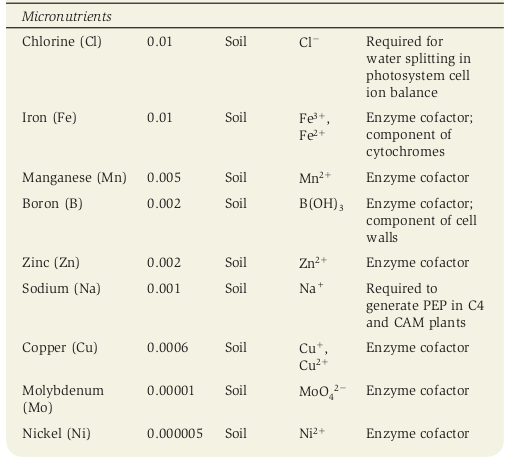
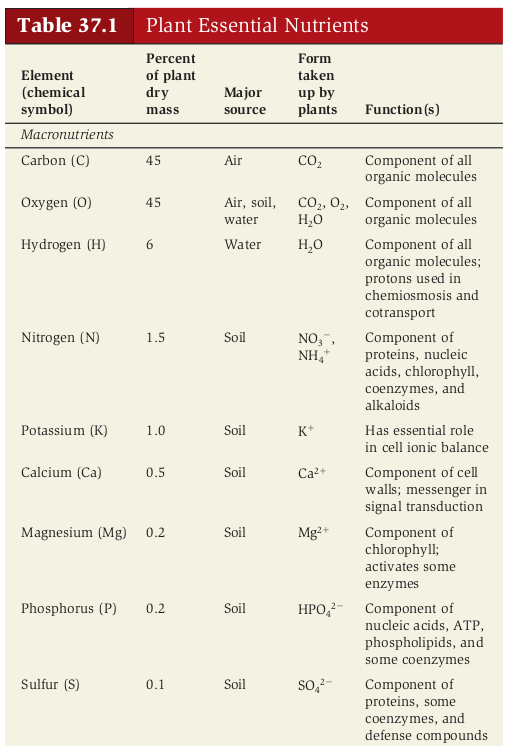
### Macronutrients

- required in amounts of atleast 1g per 1kg of dry plant mass

### Micronutrients

- trace elements
- required in amounts at or less than 0.1g per 1kg of dry plant mass

### Limiting factors

- resources that can limit plant growth 
    - too little or too much
- carbon dioxide
- water
- other mineral nutrients

<table border="1" id="bkmrk-" style="border-collapse: collapse; width: 100%;"><tbody><tr><td style="width: 50%;">[![Screenshot-from-2019-02-26-23-45-26.png](https://bookstack.aronwk.com/uploads/images/gallery/2019-02-Feb/scaled-840-0/64OuQGEfLO4KRmgW-Screenshot-from-2019-02-26-23-45-26.png)](https://bookstack.aronwk.com/uploads/images/gallery/2019-02-Feb/64OuQGEfLO4KRmgW-Screenshot-from-2019-02-26-23-45-26.png)</td><td style="width: 50%;">[![Screenshot-from-2019-02-26-23-45-39.png](https://bookstack.aronwk.com/uploads/images/gallery/2019-02-Feb/scaled-840-0/lU4W1Yqu4JqaVZCC-Screenshot-from-2019-02-26-23-45-39.png)](https://bookstack.aronwk.com/uploads/images/gallery/2019-02-Feb/lU4W1Yqu4JqaVZCC-Screenshot-from-2019-02-26-23-45-39.png)</td></tr></tbody></table>

# Chapter 38

## Transport of materials in plants

- Root system absorbs water and dissolved minerals from the soil
- Shoot system takes CO2 from the atmosphere via stomata
- Photosynthetic cells use these materials to produce organic compounds needed for growth and reproduction
- long-distance transportation occurs withing the plant body using a continuous system of conducting materials 
    - Xylem 
        - transport water and dissolved minerals
        - Only goes up
    - Phloem 
        - transports food and other solutes (hormones)
        - Goes up and down

[![Screenshot-from-2019-02-27-18-14-30.png](https://bookstack.aronwk.com/uploads/images/gallery/2019-02-Feb/scaled-840-0/DshAG72dEMyIUHb8-Screenshot-from-2019-02-27-18-14-30.png)](https://bookstack.aronwk.com/uploads/images/gallery/2019-02-Feb/DshAG72dEMyIUHb8-Screenshot-from-2019-02-27-18-14-30.png)

## Importance of water

- Photosynthesis
- support of plant organs
- conduction
- cell elongation
- most chemical reactions
- Average plant is 90% water
- Solvent for most substances 
    - Solution 
        - Solvent
        - Solute

### Properties of water

- Polar molecule 
    - neutral
- Hydrogen bonding
- Cohesiveness
- Adhesiveness
- Temperature Stabilizer
- Transport medium
- Best biological solvent
- Occurs in all 3 forms of matter within earth's temperature range

## Principles of movement

- Bulk\\Mass flow 
    - Mass movement of liquid cause by pressure and\\or gravity
    - Ex: leaching 
        - movement of ion though soil to plant roots
    - Faster than diffusion
- Diffusion 
    - high concentration &gt; low concentration
    - Simple diffusion 
        - Movement of molecules through a phospholipid bilayer down a concentration gradient
    - Facilitated Diffusion 
        - transport of molecules across a plasma membrane down a concentration gradient with the aid of membrane protiens
- Osmosis"gatekeeper" 
    - Diffusion across a selectively permeable membrane in response differences in solute concentration
    - simple diffusion of water does not occur rapidly enough for rapid expansion of plant cells
    - Aquaporins 
        - protein channels that allow facilitated diffusion of water

### Tissue-level transport

- trans-membrane transport 
    - export of material via membrane proteins, followed by import of the same substance by an adjacent cell
    - Ex. Auxin transport aided by carrier protiens
- Symplastic Transport 
    - Movement from cytosol of one cell to cytosol of another cell via plasmodesmata 
        - Cytosol 
            - Everything inside the cell wall
- Apoplastic transport 
    - movement along cell walls and inter-cellular spaces
    - Ex: water and disolved minerals

## Cellular water content

- water content of plant cells depends on osmosis, which depends on: 
    - Solute concentration
    - Turgor preassure 
        - hydrostatic pressure that increases as water enters plant cells
        - cell walls restrict the extent to which the cells can swell

[![1280px-Turgor_pressure_on_plant_cells_diagram.svg.png](https://bookstack.aronwk.com/uploads/images/gallery/2019-02-Feb/scaled-840-0/DOm5yzfVEpxRxuqu-1280px-Turgor_pressure_on_plant_cells_diagram.svg.png)](https://bookstack.aronwk.com/uploads/images/gallery/2019-02-Feb/DOm5yzfVEpxRxuqu-1280px-Turgor_pressure_on_plant_cells_diagram.svg.png)

- - Turgid plant cell has cytosol full of water and plasma membrane pushes up against the cell wall
    - Plasmolyzed cell has lost so much water that turgor pressure is lost and the plasma membrane no longer presses on the cell wall

## Water potential

- Potential energy of water
- Water moves from highest to lowest water potential 
    - affected by 
        - pressure
        - solute concentration
        - other factors (damage, temperature)
- Concept used in 2 ways 
    - to understand the movement of water into and out of cells (cellular water potential)
    - to understand the movement of water between entire plants and their enviroments

## Water (and soil mineral) movement through the plant

- Transpiration 
    - Evaporation of water from plant surfaces
    - "cost" for the plant to live on land
    - capable of pulling water up by bulk flow
    - primary form of long distance water transportation in plants

[![schematic_gas_exchange_across.png](https://bookstack.aronwk.com/uploads/images/gallery/2019-02-Feb/scaled-840-0/Sn4bFqEygOIzvHXk-schematic_gas_exchange_across.png)](https://bookstack.aronwk.com/uploads/images/gallery/2019-02-Feb/Sn4bFqEygOIzvHXk-schematic_gas_exchange_across.png)

- Stomata 
    - Opening has 2 guard cells 
        - control balance of CO2, O2, and H2O inside leaf

### Xylem

- Flowering plant xylem consists of 4 types of cells

1. Xylem parenchyma cells
2. Thick-walled supportive fibers 
    - may be alive or dead at maturity
3. vessel elements 
    - Speacilized water conducting cells and are always dead and empty of cytosol when mature
    - Wide tubes
4. Tracheids 
    - tracheory elements 
        - Rich in lignin which offers strength, durability, and water proofing
    - Narrow tubes

### Stomata

- Plants produce a waxy cuticle to prevent water loss
- stomata facilitate gas exchange
- 90% of water that evaporates from plants is lost through stomata
- when stomata are open, O2 and water vapor are released and CO2 is taken up
- controlled by guard cell pairs

[![Screenshot-from-2019-02-27-19-21-30.png](https://bookstack.aronwk.com/uploads/images/gallery/2019-02-Feb/scaled-840-0/2Vw3n8aLnp0cELoS-Screenshot-from-2019-02-27-19-21-30.png)](https://bookstack.aronwk.com/uploads/images/gallery/2019-02-Feb/2Vw3n8aLnp0cELoS-Screenshot-from-2019-02-27-19-21-30.png)

#### Mechanisms of Guard cells

- Daytime/sunlight 
    - CO2 is low in leaf
- Guard cells "pump" in K (potassium) 
    - Changes solute concentration
- H2O from xylem moves by osmosis onto guard cells 
    - cells become turgid
- Guard cells swell and open stomata 
    - CO2 diffusion into leaf
- "Pump" out K (potassium) 
    - H2O moves out by osmosis out of guard cells causing shrinking

- Pumping 
    - Expenditure of ATP energy

### Causes of water loss

- Sunlight energy 
    - heats up leaf causing evaporating of H2O from mesophyll cells
    - Causes a decrease in H2O concentration causing a "pull" of H2O
    - This "pull" moves H2O though the "Transpiration stream"

#### Transpiration Stream

- Soil H2O (and nutrients)
- root epidermis
- root cortex
- endodermis
- root xylem
- stem xylem
- leaf xylem
- mesophyll
- Vapor into atmosphere

Unidirectional movement  
Only goes UP!

#### C-A-T Mechanism

- Occurs once the stomata are open
- Purely a physical process
- "pull" of H2O one molecule at a time
- unidirectional movement
- **C**ohesion 
    - H2O molecules stick together
- **A**dhesion 
    - H2O adheres to cellulose in cell walls
- **T**ension 
    - "pull" due to H2O loss from mesophyll
- NO ENERGY expended
- Only energy is sunlight heating leaf

## Solute movement in plants

- Translocation 
    - movement of solutes in plants
- food 
    - dissolved in H2O
    - Moved in form of Sucrose
- Goes form Source to Sink 
    - Site with excess of carbohydrate
    - Site where the carbohydrate is stored or immediately needed
- Bidirectional

### Long-distance transport in phloem

- Phloem transports sugars from where they are produced and\\or stored to other sites where they are stored and/or needed 
    - Source &gt; Sink
- Primary Phloem 
    - Occurs in the vascular bundles of herbaceous plants
- Secondary Phloem 
    - Occurs as the inner bark of woody plants

### Phloem Structure

- Phloem of flowering plants in composed of **supporting fibers**, **parenchyma cells**, **sieve-tube elements**, and **adjacent companion cells (members)**
- Sieve-tube members (STM) are arranged end-to-end , and together with companion cells, form a system to transport soluble organic substances 
    - Sieve-tube members lose their nucleus and most of the cytoplasm to reduce obstruction to bulk flow
    - phloem sap passes through sieve plate pores

[![Screenshot-from-2019-02-27-19-58-17.png](https://bookstack.aronwk.com/uploads/images/gallery/2019-02-Feb/scaled-840-0/ix1uZ2m942od7BE6-Screenshot-from-2019-02-27-19-58-17.png)](https://bookstack.aronwk.com/uploads/images/gallery/2019-02-Feb/ix1uZ2m942od7BE6-Screenshot-from-2019-02-27-19-58-17.png)

[![Screenshot-from-2019-02-27-19-58-27.png](https://bookstack.aronwk.com/uploads/images/gallery/2019-02-Feb/scaled-840-0/XtH8sKXugg4zutpv-Screenshot-from-2019-02-27-19-58-27.png)](https://bookstack.aronwk.com/uploads/images/gallery/2019-02-Feb/XtH8sKXugg4zutpv-Screenshot-from-2019-02-27-19-58-27.png)

#### Pressure Flow Hypothesis

##### At source

1. Companion cells "pump" sucrose into STM (STP expended)
2. As sucrose concentration increases in STM, water potential (concentration) decreases within STM
3. Adjacent Xylem has higher water potential than STM, H2O moves into STM by osmosis

Bulk flow of Sucrose  
Higher Pressure &gt; lower Pressure

##### At sink

1. Companion cells unload sucrose (ATP expended)
2. Sucrose converted into starch for storage in root cortex
3. Without sucrose, higher H2O potential in STM
4. H2O moves from STM to adjacent Xylem by osmosis

[![Screenshot-from-2019-02-27-19-58-44.png](https://bookstack.aronwk.com/uploads/images/gallery/2019-02-Feb/scaled-840-0/CBI6gxoEwuZ3u7k7-Screenshot-from-2019-02-27-19-58-44.png)](https://bookstack.aronwk.com/uploads/images/gallery/2019-02-Feb/CBI6gxoEwuZ3u7k7-Screenshot-from-2019-02-27-19-58-44.png)

- ATP spent only by companion cells at source (loading) and sink (unloading)
- Bulk flow (pressure/potential differences) and osmosis (H2O potential\\concentration differences) 
    - No energy Expended

## Similarities Between Translocation and Transpiration

- Both involve conduction
- both involve physical properties of H2O

<table border="1" id="bkmrk-translocation-transp" style="border-collapse: collapse; width: 77.5195%;"><tbody><tr><td class="align-center" style="width: 36.1166%;">Translocation</td><td class="align-center" style="width: 41.2111%;">Transpiration</td></tr><tr><td style="width: 36.1166%;">- Phloem
- Bidirectional
- Must expend ATP energy by plant

</td><td style="width: 41.2111%;">- Xylem
- Unidirectional
- Sunlight energy (no expenditure by plant)

</td></tr></tbody></table>

# Chapter 39

## Reproduction in plants

- Most flowering plants display sexual reproduction 
    - Two gametes fuse to produce offspring with a unique combination of genes
- They undergo <span style="text-decoration: underline;">Alternation of Generations</span>
    - Two multicellular life cycle stages
    - diploid 
        - Spore producing sporophyte 
            - produces spores by meiosis 
                - a type of cell division that results in four daughter cells each with half the number of chromosomes of the parent cell, as in the production of gametes and plant spores.
    - haploid 
        - Gamete producing gametophyte 
            - produces gametes by mitosis 
                - a type of cell division that results in two daughter cells each having the same number and kind of chromosomes as the parent nucleus, typical of ordinary tissue growth.
- Egg is Female
- Sperm is Male

[![Screenshot-from-2019-02-27-20-43-03.png](https://bookstack.aronwk.com/uploads/images/gallery/2019-02-Feb/scaled-840-0/UaSqYxHWtFy7Qc4C-Screenshot-from-2019-02-27-20-43-03.png)](https://bookstack.aronwk.com/uploads/images/gallery/2019-02-Feb/UaSqYxHWtFy7Qc4C-Screenshot-from-2019-02-27-20-43-03.png)

## Evolutionary Trends in the Plant Kingdom

- Sporophyte has become larger, more complex 
    - Flowering plants 
        - Sporophyte independent
        - Dependent gametophyte is only a few cells contained within flowers
- Gametophyte has become smaller, less complex 
    - Moss 
        - Sporophytes small and dependent on gametohyte (Dominant form)
- Female 
    - 7 cells
- Male 
    - 2-3 cells

[![Screenshot-from-2019-02-27-20-48-43.png](https://bookstack.aronwk.com/uploads/images/gallery/2019-02-Feb/scaled-840-0/kCPmVzrJKv2neXNG-Screenshot-from-2019-02-27-20-48-43.png)](https://bookstack.aronwk.com/uploads/images/gallery/2019-02-Feb/kCPmVzrJKv2neXNG-Screenshot-from-2019-02-27-20-48-43.png)

## Flower and Sexual Cycle

- Flowers 
    - ONLY in angiosperms
    - All sizes, shapes, colors, and aromas
- Essential process of Sexual reproduction occurs within flowers 
    - Meiosis/cytokenesis 
        - reduces chromosome number
    - Syngamy (fertilization) 
        - restores chromosome number

## "Ideal" Flower

- Uses highly modified leaves arranged in whorls (circular) at the tip of a highly modified stem
- A flower is a highly modified determinate (short term) shoot system

[![Screenshot-from-2019-02-27-21-31-46.png](https://bookstack.aronwk.com/uploads/images/gallery/2019-02-Feb/scaled-840-0/6gx5mlE0Jyvaj1nE-Screenshot-from-2019-02-27-21-31-46.png)](https://bookstack.aronwk.com/uploads/images/gallery/2019-02-Feb/6gx5mlE0Jyvaj1nE-Screenshot-from-2019-02-27-21-31-46.png)

- Pedical, receptical, 4 sets of highly modified leaves are all 2N and part of the sporophyte generation
- Pollen (sperm) and eggs of embryo sac are part of the 1N generation
- Pedical 
    - flower stalk
- Recepticle 
    - tip of modified stem with 4 whorls attached

## Sexual Cycle

[![Screenshot-from-2019-02-27-21-34-37.png](https://bookstack.aronwk.com/uploads/images/gallery/2019-02-Feb/scaled-840-0/jdK9UFdS3EQL8wjb-Screenshot-from-2019-02-27-21-34-37.png)](https://bookstack.aronwk.com/uploads/images/gallery/2019-02-Feb/jdK9UFdS3EQL8wjb-Screenshot-from-2019-02-27-21-34-37.png)

[![Screenshot-from-2019-02-27-21-37-45.png](https://bookstack.aronwk.com/uploads/images/gallery/2019-02-Feb/scaled-840-0/rWpi8vuGXj6WiaVB-Screenshot-from-2019-02-27-21-37-45.png)](https://bookstack.aronwk.com/uploads/images/gallery/2019-02-Feb/rWpi8vuGXj6WiaVB-Screenshot-from-2019-02-27-21-37-45.png)

### Male

- Pollen formation 
    - occurs within the anther of stamen
- Anther 
    - Bilobed with 2 pollen chambers per lobe

[![922bc112d7d7f455d12aa057c7c9ce47.jpg](https://bookstack.aronwk.com/uploads/images/gallery/2019-02-Feb/scaled-840-0/W4kDUsmWtcjg6NN2-922bc112d7d7f455d12aa057c7c9ce47.jpg)](https://bookstack.aronwk.com/uploads/images/gallery/2019-02-Feb/W4kDUsmWtcjg6NN2-922bc112d7d7f455d12aa057c7c9ce47.jpg)

1. 2N microspore mother cell
2. meiosis/cytokenesis
3. 4 1N microspores
4. Each: mitosis/cytokenesis  
    unequal and incomplete
5. 1N Generating cell  
    1N Tubecell

Male Gametophyte

[![Screenshot-from-2019-02-27-22-15-33.png](https://bookstack.aronwk.com/uploads/images/gallery/2019-02-Feb/scaled-840-0/wClGUK8ETPCxCDl3-Screenshot-from-2019-02-27-22-15-33.png)](https://bookstack.aronwk.com/uploads/images/gallery/2019-02-Feb/wClGUK8ETPCxCDl3-Screenshot-from-2019-02-27-22-15-33.png)

#### Pollination

- Transfer of pollen from the anther to the stigma
- Self-pollination 
    - Transfer with the same flower or between flowers on the <span style="text-decoration: underline;">same plant</span>  
        
        - - - - - - - - - - - - - - - - - - - - - - - - - - - - - -
- Cross-Pollination 
    - Transfer between flowers of other plants

##### Pollinating Agents

Mechanisms utilized for transfer of pollen

1. Wind 
    - small/lightweight pollen
2. Water 
    - Transfer with a few aquatic plants
3. Animals 
    - Majority of plants
    - Utilized as a "trick and reward" system
    - nectar, colors, and aromas to attract animals

### Female

Ovule Development

- Ovule 
    - future seed
- Enclosed within the ovary of pistol (carpel)
- One to many ovules per ovary 
    - ovary will become fruit
- Ovule attached to central axis or to wall of hollow fruit 
    - always enclosed
    - angiosperms
- within ovule is 1 large 2N cell 
    - megaspore mother cell

[![20190227_222436.jpg](https://bookstack.aronwk.com/uploads/images/gallery/2019-02-Feb/scaled-840-0/nFInSj1sgaU98zAk-20190227_222436.jpg)](https://bookstack.aronwk.com/uploads/images/gallery/2019-02-Feb/nFInSj1sgaU98zAk-20190227_222436.jpg)

1. 2N megaspore mother cell
2. meisos/sytokenesis
3. 4 1N Megaspores
4. 3 degrade
5. 2N Functional megaspore
6. Series of 3 mitosis/cytokenesis cycles  
    Incomplete and unqueal
7. 7-celled embryo sac  
    8 nuclei

Female gametophyte

[![embryo-sac.gif](https://bookstack.aronwk.com/uploads/images/gallery/2019-02-Feb/U0gQuMvC2mrSvdDK-embryo-sac.gif)](https://bookstack.aronwk.com/uploads/images/gallery/2019-02-Feb/U0gQuMvC2mrSvdDK-embryo-sac.gif)

[![Screenshot-from-2019-02-27-22-15-55.png](https://bookstack.aronwk.com/uploads/images/gallery/2019-02-Feb/scaled-840-0/iWWVysmvIq1CzhVd-Screenshot-from-2019-02-27-22-15-55.png)](https://bookstack.aronwk.com/uploads/images/gallery/2019-02-Feb/iWWVysmvIq1CzhVd-Screenshot-from-2019-02-27-22-15-55.png)

- 1N Functional megaspore 
    - 3 mitosis/cytokenesis divisions
- One cell with 1 nucleus becomes 8 nuclei but only 7 cells

#### Embryo sac

- 8 nuclei, 7 cell structure
- female gametophyte
- 3 antipodal cells (1N) 
    - opposite end from micropyle
- 1 central cell with 2 large 1N polar nuclei
- 2 Synergids (1N) 
    - Micropyle end on outside
- 1 egg (1N) 
    - Middle at micropyle end

### Syngamy (fused gametes)

- 1N egg + 1N sperm = 2N zygote (single fertilized egg)
- Pollen grain germination 
    - tube cells form pollen tube (delivers sperm)
    - generative cell divides by mitosis/cytokenesis to produce 2 sperm

[![Screenshot-from-2019-02-27-22-45-54.png](https://bookstack.aronwk.com/uploads/images/gallery/2019-02-Feb/scaled-840-0/vL8i78rPOWMcXIqI-Screenshot-from-2019-02-27-22-45-54.png)](https://bookstack.aronwk.com/uploads/images/gallery/2019-02-Feb/vL8i78rPOWMcXIqI-Screenshot-from-2019-02-27-22-45-54.png)

- Pollen tube enters micropyle 
    - digests tube cell nucleus
- Pollen tube enters one synergid 
    - releases it's content (sperm)
    - synergid ruptures
    - mycropyle closes

- "Double fertilization" (double fusion) 
    - 1N egg +1N sperm = 2N zygote
    - 1N sperm +2 1N polar nuclei = 3N primary endosperm cell

- Post fertilization with ovule
- 2N zygote grows by mitosis/cytokenesis into 2N multicellular embryo
- 3N primary endosperm cell grows by mitosis/cytokenesis into 3N multicellular endosperm 
    - nutrient tissue for embryo

- Ovule/ovary with 2N zygote mature/enlarges with sugars/H2O into a fruit (mature ovary) with enclosed seeds (mature ovules)
- Seed dispersal (seeds enclosed withing a fruit)
- agents 
    - wind
    - water
    - animals - majority

## Seed germination

- Seed with 2N embryo enters period of dormancy
- dormancy broken by a combination of internal (hormones) and external factors (environmental)
- radical (first root) emerges and grows down
- shoot emerges and grows up

# Exam 3 - Notes

# Chapter 40

## Intro to Animal Structure(Form) &amp; Function

### Key concepts

- organization of animal bodies
- the relationship between structure and function
- homeostasis

### All Animals:

Share similarities in the ways in which they:

- Exchange materials with their surroundings
- Obtain energy from organic molecules
- synthesize complex molecules
- reproduce themselves
- detect and respond to signals in their immediate surroundings

## Levels of Animal Organization

- Cellular 
    - Phylum Porifera
- Tissue 
    - Phylum Cnidaria
    - Phylum Ctehotophora
- Organ System 
    - All advanced animal groups

### Internal Organization of Animals

[![Screenshot-from-2019-03-31-13-15-50.png](https://bookstack.aronwk.com/uploads/images/gallery/2019-03-Mar/scaled-840-0/SsLROTRAJmjnIpxu-Screenshot-from-2019-03-31-13-15-50.png)](https://bookstack.aronwk.com/uploads/images/gallery/2019-03-Mar/SsLROTRAJmjnIpxu-Screenshot-from-2019-03-31-13-15-50.png)

- **Cells** with similar properties group together to form **tissues**
- **Tissues** combine together to form **organs**
- **Organs** are linked together to form **organ systems**
- **Organ Systems** form an **organism**

## Tissues

### Tissue

- An association of many cells that have a similar structure and function

#### Types

- Epithelial tissue
- Connective tissue
- Muscle tissue
- Nervous tissue

## Epithelial

- Sheets of densely-packed cells that: 
    - cover the body or enclose organs
    - line the walls of the body cavity and organs
- Specialized to protect and secrete/absorb ions and organic molecules
- cells have a variety of shapes 
    - 
    - cuboidal
    - squamous
    - columnar
- arranged to form different types of tissues 
    - simple 
        - one layer
    - stratified 
        - multi layer
    - pseudo-stratified 
        - one layer, but appears stratified
- All are asymmetrical or polarized 
    - One side rests on the basal lamina (basement membrane)
    - the other faces the environment

[![Screenshot-from-2019-03-31-13-32-03.png](https://bookstack.aronwk.com/uploads/images/gallery/2019-03-Mar/scaled-840-0/fTvJc1v4hcMhFr57-Screenshot-from-2019-03-31-13-32-03.png)](https://bookstack.aronwk.com/uploads/images/gallery/2019-03-Mar/fTvJc1v4hcMhFr57-Screenshot-from-2019-03-31-13-32-03.png)

### Types of Epithelial Tissue

- Simple squamous 
    - one layer of flat cells
- Simple cuboidal 
    - one layer of square cells
- Simple columnar 
    - single layer of rectangular cells
- Pseudo-stratified columnar 
    - 1 cell thick with all at basement barrier
- Stratified squamous 
    - multi-layered flattened cells
- Transitional 
    - stretchable tissue

All may be involved with secretions/absorption/protection

## Connective tissues

Connect, surround, anchor, bind, &amp; support

- For extracellular matrix (ECM) around cells 
    - provides scaffolds for attachment
    - protects and cushions
    - mechanical strength
    - transmit information
    - transport

[![Screenshot-from-2019-03-31-14-24-53.png](https://bookstack.aronwk.com/uploads/images/gallery/2019-03-Mar/scaled-840-0/hwo10hhhAPdUjR21-Screenshot-from-2019-03-31-14-24-53.png)](https://bookstack.aronwk.com/uploads/images/gallery/2019-03-Mar/hwo10hhhAPdUjR21-Screenshot-from-2019-03-31-14-24-53.png)

### Types of Connective tissue

- Blood 
    - transport and protection
- adipose (fat) 
    - insulation, protection, support, and storage
- bone 
    - support, protections, and movement
- cartilage 
    - support and flexibility
- loose connective tissue 
    - holds internal organs in place
- dense connective tissue 
    - strength and support

## Muscle Tissues

Cells specialized to contract, generating mechanical force

[![Screenshot-from-2019-03-31-14-29-34.png](https://bookstack.aronwk.com/uploads/images/gallery/2019-03-Mar/scaled-840-0/VTF34jeaQCqagVni-Screenshot-from-2019-03-31-14-29-34.png)](https://bookstack.aronwk.com/uploads/images/gallery/2019-03-Mar/VTF34jeaQCqagVni-Screenshot-from-2019-03-31-14-29-34.png)

### Types of muscle tissue

- Skeleton muscle 
    - attached to bone(via connective tissue) or exoskeleton for locomotion
    - elongated fibers
    - voluntary control
    - striated
- Smooth muscle 
    - surrounds tubes and body cavities for propulsion of contents
    - flattened cells
    - involuntary control
- cardiac muscle 
    - only in the heart
    - elongated fibers
    - involuntary control
    - striated
    - branched

## Nervous tissue

- complex networks of neurons (nerve cells)
- initiate and conduct electrical signals from one part of the body to another
- electrical signals produced in one neuron may stimulate or inhibit other neurons 
    - initiate new electrical signals
    - stimulate muscle cells to contract
    - stimulate glandular cells to release chemicals
- also contains neuro-glial cells  
    
    - more numerous than neurons
    - provide metabolic support, maintenance, ion balance, and cleaning for the neurons

[![Screenshot-from-2019-03-31-14-34-41.png](https://bookstack.aronwk.com/uploads/images/gallery/2019-03-Mar/scaled-840-0/ZguzB7s34fWJq1aW-Screenshot-from-2019-03-31-14-34-41.png)](https://bookstack.aronwk.com/uploads/images/gallery/2019-03-Mar/ZguzB7s34fWJq1aW-Screenshot-from-2019-03-31-14-34-41.png)

[![Screenshot-from-2019-03-31-14-36-03.png](https://bookstack.aronwk.com/uploads/images/gallery/2019-03-Mar/scaled-840-0/8JKetSBDcEZizMrW-Screenshot-from-2019-03-31-14-36-03.png)](https://bookstack.aronwk.com/uploads/images/gallery/2019-03-Mar/8JKetSBDcEZizMrW-Screenshot-from-2019-03-31-14-36-03.png)

## Organ Systems

[![Screenshot-from-2019-03-31-14-38-56.png](https://bookstack.aronwk.com/uploads/images/gallery/2019-03-Mar/scaled-840-0/nO3BhrG38RgJcgjQ-Screenshot-from-2019-03-31-14-38-56.png)](https://bookstack.aronwk.com/uploads/images/gallery/2019-03-Mar/nO3BhrG38RgJcgjQ-Screenshot-from-2019-03-31-14-38-56.png)

10 organ systems that we will cover (not in this order)

### Structure and function

- organization of structure(form) can predict the function of a structure
- we will concentrate of the increasing complexity of structural(form), and thus the increasing complexity of organismal function
- most emphasis on vertebrates

### Homeostasis

- changing variables in environmental: 
    - air temperature
    - water temperature
    - food supply
    - water supply
    - pH
    - <span style="font-size: 15px;">O<sub>2</sub></span> Concentration
- Process of adjusting to the external environment and maintaining a stable internal environment

# Integumentary System

<p class="callout info">Apparently there is no chapter/section for this in the book?</p>

## Integument

- the skin and all accessory structure (hair, feathers, scales)

## Skin

- The largest vertebrate organ
- major part of the integument system

## Vertebrate integument and derivatives

### Functions

- Protection form abrasion
- protects against water loss
- barrier to disease causing pathogens
- protection from UV light
- temperature regulation
- contains sensory receptors
- excretion (limited)

### Vertebrate Integument

- skin and all other accessories
- skin is the largest organ o vertebrates
- skin consists of 2 layers 
    - epidermis
    - dermis

### Epidermis

- outer layer
- nutrients diffuse into the epidermis form the dermis
- stratified squamous epithelial cells

#### Cell types

- langerhans cells 
    - defensive cells
- Melanocytes 
    - produce pigment melanin
    - skin coloration
    - protect form UV light
- Merkel cells 
    - touch receptors
- Keratinocytes 
    - primary cell type
    - produce insoluble protein Keratin
    - amount of keratin increases from the inside to outside
    - keratin fill cytoplasm and impairs nutrient diffusion, cell dies

### Dermis

- Inner layer of skin 
    - thinner than dermis
- highly vascularized
- contains: 
    - sensory structures
    - vessels
    - nerves
    - glands
- Origin of hair/scales/feathers in vertebrates
- Sensory structures 
    - Meissner's corpuscles 
        - light touch
    - Pacinian corpuscles 
        - deep vibrations

#### Sweat Glands

- temperature regulation
- produce sweat (primarily water) 
    - evaporating cooling
    - release of waste ions
- 2.5 million on the body
- release of heat

#### Sebaceous Glands

- all over body, except palms and soles
- large on face, neck, and upper chest
- produce sebum 
    - lubricates and soften hair and skin
    - water proofing in aquatic mammals

### Hypodermis

- subcutaneous layer 
    - below the dermis
- not a layer of the skin
- contains much adipose (fat) tissue
- females have thicker layer of adipose tissue than males

#### Function

- body contour
- insulation
- support the skin

# Chapter 45 & 46

## Digestive System

### Key Concepts

- Animal nutrition
- general principles of digestion and absorption of food
- overview of vertebrate digestive systems
- mechanisms of digestion and absorption in vertebrates

## Intro to nutrition

- nutrient 
    - any substance taken in by an organism that is needed for: 
        - survival
        - growth
        - development
        - tissue repair
        - or reproduction
- nutrition 
    - process of consuming and using food for nutrients
- animals receive nutrients by consuming food

### Dietary categories

- basic similarities in organ system function lead to similarities in nutritional requirements
- different animal physiologies can have different nutrient demands

- Herbivores 
    - eat only plants
    - digestive system contains micro-organisms that help digest cellulose
- Carnivores 
    - eat only animal flesh or fluid
- Omnivores 
    - eat both

### Animals are heterotrophic

- Heterotrophs 
    - ingest feeders
- cannot manufacture more food
- require already synthesized organic compounds of plants of other animals to supply materials 
    - survival
    - maintenance
    - growth
    - reproduction

## Gut Tracts

Two types

1. Blind Gut 
    - no cavity between gut and body wall
    - one opening
    - primitive form
2. tube-within-a-tube 
    - flow through digestive tube
    - body cavity between git and body wall
    - separate opening (mostly)

## Digestion

- the breakdown of large molecules into smaller ones

### Digestive enzymes (hydrolases)

- carbohydrases
- proteases
- lipases
- nucleases

### Food processing in animals

Occurs in Five phases

1. Ingestion 
    - food is taken into the body and moves into a digestive
2. digestion 
    - food is broken down into smaller molecules
    - chemical and mechanical
3. transport
4. absorption 
    - ions, water, and small molecules are transported into the circulatory system
5. egestion 
    - undigested materials and other waste are passed from the body
    - elimination or exceretion

### Alimentary canal

- digestive tract or tube 
    - Gastrointestinal tract
- Five regions of food processing
- Single tube with opening at each end
- contains smooth muscles in walls
- lined with epithelial cells 
    - synthesize and secrete digestive enzymes
    - secrete hormones
    - transport digestive materials
- several specialized regions 
    - different structures for different processes
    - storage area

#### Structure of GI Tract

- some general structure from midpoint of esophagus, to the anus or cloaca 
    - lumen lined by epithelial and glandular cells
    - secretory cells release a protective layer of mucus
    - other cells release hormones
    - glands release enzymes, acids, water, and ions
- Epithelial cells linked by tight junctions and surrounded by layers of tissue made of smooth muscle, neurons, connective tissues, and blood vessels 
    - neurons activated by sight and smell of food and presence of food in tract

#### Region of Reception

##### Buccal cavity

- mouth and accessory structures
- ingestion site and digestion site
- chemical and mechanical
- jaws, teeth, cheek muscles, tongue, and salivary glands (saliva)

##### Pharynx

- back of mouth cavity
- point that respiratory and digestive system cross paths

#### Region of Conduction

##### Esophagus

- - tube carrying materials from mouth cavity to the rest of the alimentary canal
    - forces/pushes good down
    - conducts food from pharynx to stomach
    - Peristalsis 
        - rhythmic wave-like contractions which propel food forward in the GI tract
    - No new digestion here 
        - only chemical continuation from buccal cavity

#### Region of digestion and storage

##### Stomach (mostly)

- - saclike organ evolved for storing food
    - muscular nature helps break up food
    - partial protein digestion
    - regulates rate of emptying into small intestine
- Secretions 
    - hydrochloric acid 
        - kills microbes
        - dissolves particulate matter
        - secreted by parietal cells
    - Pepsinogen 
        - converted to pepsin to begin protein digestion
        - secreted by Chief cells
- Epithelium coated with an alkaline mucus
- carbohydrate digestion continues from mouth
- little lipid digestion happens
- lumen (cavity) stomach 
    - pepsinogen + HCL -&gt; pepsin (for protein breakdown)

#### Region of terminal digestion and absorption

##### Small intestine

- near

# Chapter 41 - 43 (mostly 41)

## Nervous System

# Chapter 44

## Musculoskeletal system